Showing posts with label William Hartnell. Show all posts

Tuesday, 9 October 2012

The Hartnell Years


William Hartnell is the Doctor. Whilst he may not have been the longest running, and he certainly isn’t the most popular in most polls held, he originated the role, bringing his own irascibility and grumpiness, but also his lovability and charm. His wit and sardonic humour radiate from him endlessly, and even in the direst of situations, his “hmm”s and tuts warm my heart.

Of course, he is renowned for his ‘Billy fluffs’ –invariably at least once an episode, Hartnell can stumble on a line. These are often cited by some as a reason for disliking his portrayal. That said, for a man of his age and in his condition, we can only sit and sigh in awe at the durability of him. Rehearsing almost every week of the year, on a dreadfully tight budget and schedule, Hartnell and his crew managed admirably. Considering his disease, he actually fared surprisingly well – there are bit-part players who fluff as often, despite only having the script for two-four weeks. In the 1960s, as we know, only one take was often allowed – due to time constraints, the show was filmed ‘as live’, and retakes were only allowed for the most catastrophic of reasons. As such, he endured being dropped on camera cranes, being hit in the face, and any number of terrible things – yet throughout everything, he managed to hide most of this, behind his genius characterisation of the Doctor as a doddery old man.

He is unfairly criticised as being too inactive – all of the ‘heavy lifting’ was left to his (admittedly more than) capable companions, Ian, Steven and Ben. Certainly, we don’t see him prat-falling around like McCoy and Baker, or energetically throwing himself around like Davison, or moving with a nimble, child-like glee like Troughton, or even karate-chopping henchmen like Pertwee. But that doesn’t make him any less the Doctor.

We must remember, though, that he is the First. He is the archetype of the character, the originator of many of the character’s attributes which we still see today. Without Hartnell (and the Daleks, admittedly) the series may never have run for three years, let alone 49. He took the essence of a character created by writers and made it his own. He actively changed scripts if he thought them inappropriate for the children watching.


What Hartnell does is encapsulate all that later Doctor’s embody in one go – he is loveable and miserable, grouchy and snappy, funny and clownish, abrupt and deceitful, all at once. His stories helped in that each script allowed him to bring a new trait to the fore – from the antihero liar of The Daleks to the lovable pragmatist and historical hero of The Aztecs, from moral peace-keeper in The Sensorites to the heroic old man who battles adversity in the face of illness in The Tenth Planet, he managed to create the template which is still being used to this very day. Many unfairly ignore Hartnell, and claim that it was Patrick Troughton who created the role as we now know it, and whilst Troughton is far and away my favourite Doctor, he simply took Hartnell’s lead. 

The joker of The Romans and The Myth Makers is the ball that Troughton, Tom Baker and early Sylvester McCoy picked up and ran with. The stoic pragmatist and heroic action man of The Dalek Invasion of Earth and The Tenth Planet is the template upon which Jon Pertwee, Peter Davison, David Tennant and Matt Smith modelled themselves on. The unapproachable and aggressive Doctor of An Unearthly Child and The Daleks seems to be the template for Colin Baker’s interpretation – admittedly one which should have gone full circle to encapsulate all of his traits rather than just those irascible ones. The darker and more dangerous characteristics of Hartnell’s Doctor are the template upon which later McCoy, Christopher Eccleston and later Smith will utilise.
Of course, the series itself had no consistency as such to speak of, so it is unsurprising that there seemed to be little or no consistency to the character or the stories he was involved in. And that is also the crux of what makes Hartnell so great – put him in any era, on any planet and against any foe, and he thrives regardless. In the face of any adversity, he steps forward, a new trait comes out, and he faces the challenge admirably. As each new brush came in, carving a new way with the accompanying production team, the style changed. Whilst later Doctor’s eras are renowned for Base Under Siege style drama, or the earth-bound UNIT tales, before settling back into a hotch-potch method like in Hartnell’s time, the earliest incarnation thrives on the unknowability of what is around every bend– from historicals to sci-fi, Earth-under-threat to stories of warring factions on desolate planets, there is rarely anything similar. From the quiet, self-contained stories like Marco Polo to the epic sprawling battles of The Daleks’ Master Plan, you could never settle down knowing what was coming.

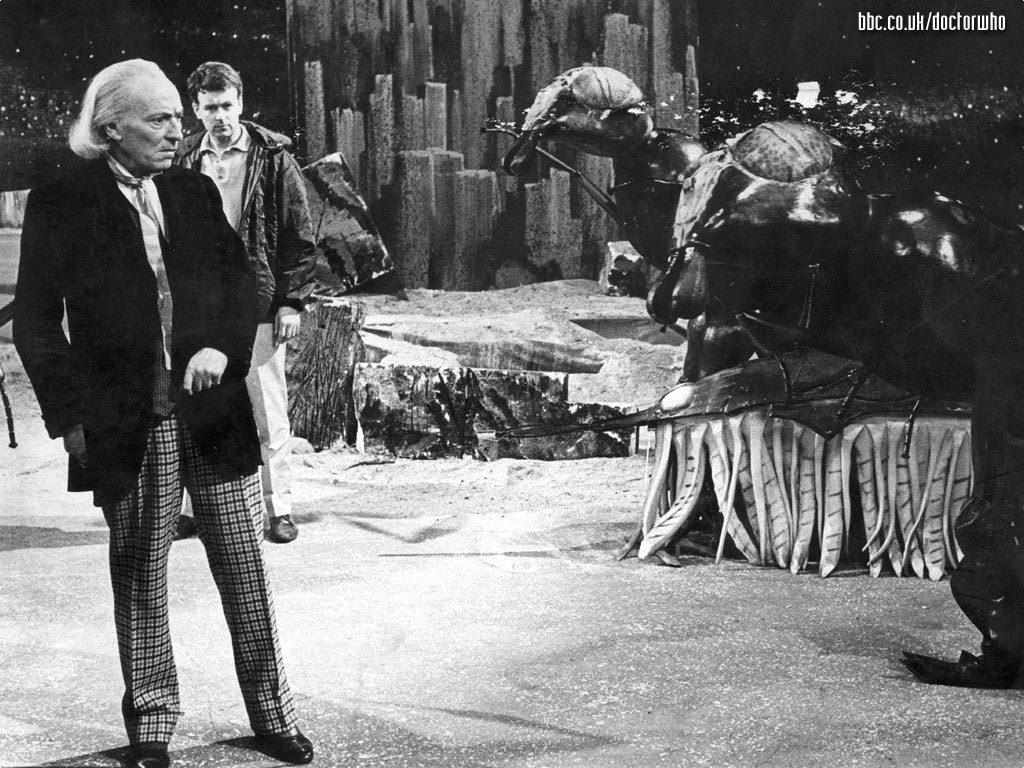
Some of these adventures work – indeed, most do. Some were wild experiments which are ambitious but sadly fall short for me due to the budgetary limitations. Whilst The Daleks’ Master Plan works wonderfully despite its epic scale, the same cannot be said for earlier attempts at this level of ambition such as The Keys of Marinus and The Chase, where multiple sets were demanded for short filming periods, resulting in shoddy-looking set pieces on shoddy-looking scenery. Likewise, ambitious projects like The Web Planet suffer, although that is principally down to the rather formulaic plot underpinning the extremely avant-garde production idea. Again, weak costuming and set design also mean that some of these projects suffer.
 
During his tenure, there was a wide variety of companions, too – again, since there was no tried and tested formula for them, they vary hugely in effectiveness. Whilst Ian, Barbara and Steven are particularly well-rounded, with a variety of idiosyncratic characteristics, others, such as Susan and Dodo sadly end up hitting wide of the mark. The characters themselves were too unreliable, varying wildly from alien school girl to shrieking hindrance in the case of Susan, and from idiotic and pointless white noise to engaging and mature young woman in the case of Dodo. From story to story, these characters were given no solid framework, and each writer took on the role as the script demanded, whether for better or worse. Always present is the boy’s own hero, perfectly embodied by Steven and Ian, and hinted at in Ben’s brief stint with this incarnation. With Hartnell’s health questionable at the best of times, this style of assistant was always needed – someone willing to roll their sleeves up and get physical. The young counterpart to Hartnell’s Doctor should have been perfectly embodied in Susan, a granddaughter of the same heritage with the same character quirks. Sadly, many of the ‘alien’ ideas were lost, and only serials like The Sensorites allow us to fully appreciate how wonderful her character could have been. Her replacement Vicki worked wonderfully, but in turn she was replaced by Dodo, whose very stupidity was so poorly sketched out that she was almost unbearable.

The rarest of companions, though, is Barbara, and it is a role that we will never see again – morally speaking, she is the Doctor’s equal, if not better. She sets him right, and helps to maintain a sense of balance. Jacqueline Hill’s performance in The Aztecs is why it is still one of the greatest Doctor-lite stories, and her ownership of her role in history, and her personal growth throughout, makes her one of my favourite companions ever.

We also have the ‘not-quite’ companions – characters like Katarina, Sara Kingdom and Bret Vyon who briefly travel with the Doctor – and again, it is testimony to Hartnell’s characterisation that at least two of these were shown to mature and grow thanks to his company. Katarina, sadly, was something of a wasted opportunity – but given that the part was originally intended for Vicki, that is unsurprising.

So all in all, with Hartnell we can see greatness – he is not one-dimensional, ever, and provides gravitas and mystery to the role, despite us finding more out about him through his character growth than we ever will with any other incarnation. He grows from his miserly first appearance, through his experiences with his companions, into a loveable, unknowable rogue, able as he is to flit between personas at the drop of a hat. Speaking of hats – on with Troughton...!

Monday, 8 October 2012

The Tenth Planet


Before I start this blog, I’d like to apologise in advance – I had written 6 pages of wonderful rhetoric, filled with insightful points of interest and fascinating observations... but then my computer deleted it.  As such, I’ve had to rewrite the entire thing, and as such it will be nowhere near as effective – I watched the serial more than a week and a half ago, and have since listened to the next two serials, as well as the series finale of the reboot, so my memory is a little hazy, and my notes make little sense.  So, sorry.

And so we come to the end.  Season 4, serial 2, sees us bid a heartfelt farewell to the Doctor – Hartnell’s moving on, and Troughton’s taking over the reins.  But what a way to bow out – the introduction of the Cybermen!  The first ever regeneration! (Although of course we don’t know that that is what it is just yet.)  But after a long and dedicated service to the character, Hartnell’s swansong is both wonderful and a tragic shame.

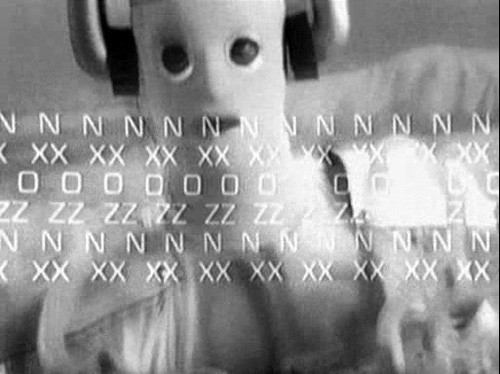
The Tenth Planet is regarded by many as the holy grail of Doctor Who, and episode 4 is the most eagerly-sought episode to be returned to the archives.  It is a fantastic serial for any number of reasons, and from the opening of episode 1, we can tell that this is something special;  the unique opening sequence lets us know that this is something special, as computer scrawl fills the screen, gradually transforming into the episode titles.  The sequences in Snow Base are equally impressive, and help to create a global sense of scale for the proceedings; as with The War Machines with its use of news broadcasters and American journalists, we are thrown into a world filled with people of every culture, albeit a number of them are racial stereotypes – from the Italian opera-chanting lothario with the sexy girl posters to the bullish brute of a General, barking orders in his brisk American accent – and we can genuinely believe that there is a danger for the whole planet, not just a suburb of London, as becomes the norm once Pertwee takes over.  Again, the use of stock footage here helps to create a sense of scale, making it all the more believable.   In a time of space exploration, the shots of rockets must have seemed magnificent. 

The arrival of the TARDIS is lovely too – the barren tundra is wonderfully realised, and the materialistion is faultless.  The costumes, too, are noteworthy of praise, as Ben, Polly and the doctor step out into a landscape as alien as any we’ve seen.  Set in the not-too-distant future of 1986, it allows the action to be carried by the performances, rather than being distracted by space-age costumes.  All of the characters are dressed in such a way that we can tell where we are, both physically and in a chronological sense.

Considering this is Hartnell’s swansong, and that he has gradually been removed from serials as a focal point, he is on top-form here again as always; his incredulous reaction to Cutler’s constant “pop”-calling is magnificently delivered.  In fact, all of the performances are top-notch, as though the crew are aware that they are making history here.  Craze, as Ben, is his typical self, heroic, disgruntled yet respectable.  Wills, as Polly, is clearly loving being the only female on show, and plays her part with a girlish glee which warms even the coldest heart. 

Perhaps the best performances, though, come from the astronauts, Williams and Shultz, on board the Zeus 4 shuttle, played by Earl Cameron and Alan White respectively.  Whilst the scenes in the cockpit of the ship have a great potential to be hokey and boring, occurring as they do in one small, claustrophobic space with no dynamic camera work, instead they become riveting, and their performances gradually become more panic-laden as they realise that the ship is slowly slipping from their control.  Each movement becomes a chore, and it is a true pleasure to watch.

The incidental music is superb, too – released on CD back in 2000, it creates a genuinely palpable threat as the chords become heavier and tenser, and accompany the visuals magically.  The final scenes of the first episode, as Mondas is revealed, are superb – again, the excellent model work helps to sell the realism (although the planet is spinning far too quickly upon its axis!) and as Hartnell warns of the impending “visitors” from this identical planet, we get to see them approach through the snow, with twanging chords and frantic pulsing sounds on the score.  The appearance of the Cybermen is fantastic, and is one of the best cliffhangers we’ve seen yet – the slow march is something we’ll see again in The Wheel in Space and The Moonbase, but for now it is original and fresh.  The scene in which one of the Cybermen swiftly deal with a scientist with a blow to the back of the head is horrifically violent, particularly as the camera feels like it has lingered on the shot just a moment too long before cutting away.  Also wonderful is the final scene, as the camera shows a close-up of the human hands of the Cyberman, impervious to cold and utterly without feeling, as it shifts the corpses uncaringly aside.
 
As with The War Machines before it, the use of news reporters in episode 2 helps to create a sense of scale, as the world wonders what on earth the new planet could mean.  The sequences in Wigner’s office at Geneva also help to sell this idea, as they desperately try to deal with the situation.  The presence of multi-national characters in non-speaking parts furthers this idea. 

In fact, much of the direction is wonderful – the scenes of the Cybermen’s arrival are spectacular, and the framing of them with snow on the camera lens is smashing.  Likewise, the use of the panning shot across the snow base as Barclay gives his speech is wonderful, showing each of the actors with nuanced characteristics, paranoia and fear etched onto their faces.
The Cybermen themselves are quite magnificent – whilst they are nowhere near as polished looking – pun intended – as they appear in Revenge of the Cybermen, and certainly nothing like as chilling as in the newer series with The Age of Steel, here, they are unnerving because they look so temporary.  Rather than perfect robots, identical and lacking any identity, instead the aliens look like they have been assembled from spare parts and junk.  The cloth faces are horrifically devoid of all human characteristics, and they tower over the crew of the polar base, chinks in their armour and all.  The speech patterns are the most horrifying thing about them, though; the actors performing the Cybermen open their mouths at random intervals whilst the voices, provided by the ever-reliable Roy Skelton and Peter Hawkins, are played in.  The modulation of the voices is terrifying – “You call them E-e-emotions” – as emphasis is put on the wrong part of the sentence, inflections fluctuating.  With the appearance of the creatures, mouth open and vacant eyes staring, it creates an horrific image of alien-ness.  Physically, the Cybermen are intimidating too, and not just because of their height.  Their sheer brute strength is displayed in a show of power when one Cyberman takes a gun and bends it as though it were made of rubber.

The claustrophobia of the shuttle scenes is swiftly cut short, as Zeus Four explodes – and the lack of emotion of the Cybermen makes it all the more horrifying, as they simply shrug it off as inevitable.  Their understanding of human emotions is terrifying, as they simply consider them to be a “weakness.”  Emotional power is quickly resumed, however, when the bullish Cutler discovers that his own son is now on a suicide mission, sent by his superiors on a pointless crusade.  His inner turmoil leads to him making a number of irrational choices, and allowing Ben to become the moral centre of the story as he tries to defuse the situation, and the Z-Bomb intended to be fired.

Episode 3 is my biggest bugbear though – not only is it the last moving images of Hartnell we’ll see, he doesn’t even appear in it!  As his health rapidly deteriorated, he called into the office to inform the crew that he was unfit to film episode 3, leading to swift rewrites.  What is incredible is that the previous serial, and the opening story of season 4, The Smugglers, had been filmed as the last block of season 3.  Hartnell had voluntarily come in to film The Tenth Planet, despite his ailing health, to provide closure for his portrayal of the character and to help usher in Patrick Troughton’s Doctor.  And really, he gets a raw deal of the whole thing.  After months of relegation, this serial should have been his grand exit, his outstanding swansong.  Whilst his illness was untimely but unavoidable, even when he is on screen, he is vastly underused. 

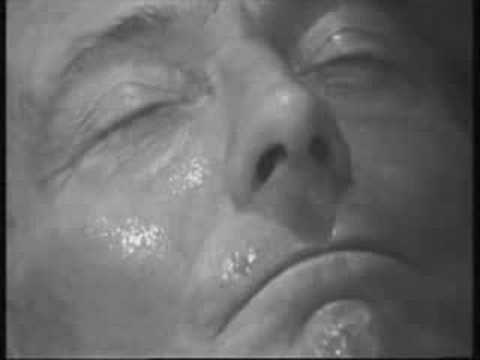
However, Hartnell’s loss was Craze’s gain, and Ben becomes the key player in this episode, crawling through ventilation systems and saving the day.  After the Doctor collapses, he is ushered into the bedroom and placed under the covers, unseen for the rest of the serial.  Ben talks to him endlessly, muttering in fact to himself about the situation, and again it is a testimony to the power of Hartnell’s Doctor – even when unconscious, he is there to provide guidance to the companions.  The camera work in the air-duct system is wonderfully handled, creating claustrophobic setting and a genuine sense of danger.  The incidental music is also wonderful, all strings and drums, rattling away as the tension is ramped higher and higher.  Ben is able to get to the control room with the Z-Bomb, but is swiftly dealt with by Cutler and his men, and we are left unsure whether his sabotage has been successful as the countdown flickers across our screens.

Of course, the rocket fails to launch, and Ben has saved the day.  Cutler’s threat is horrifying, as he tells Ben that he’s doomed for interfering with the launch, and of the Doctor, warns “he’s gonna get worse.”  The fourth episode sees both the Doctor and the Cybermen return to the foreground after their absence for the most part of episode 3.  Sadly though, as mentioned earlier, this episode is missing, save for a few poor-quality recordings made by fans who clearly knew that this was going to be something special.  In these brief clips, though, we can see just how magnificent Hartnell still was – in the face of his illness, he still stands tall against the Cybermen, with the power and disgust we have come to know and love of this incarnation.

The biggest threat to the Doctor and his companions, though, seems to come in the form of Cutler, whose emotional state threatens his sanity, and his desperation is what drives him to such acts; Robert Beatty is magnificent in these scenes, as he fluctuates from his boorish self to an emotionally-wrought man fuelled by paternal concern.  It is this very desperation which ultimately leads to his death – blinded by his concern for his son, he fails to fully appreciate the danger within the base.

Polly is swiftly taken hostage by the Cybermen, ensuring that Ben and the Doctor do as they are told, and the Doctor’s final comment to her as she leaves – “Don’t forget your coat!” – reminds us of his grandfatherly ways.  The Doctor quickly realises the Cybermen’s plan, though, and as such is also taken hostage – again, removing him from the main thrust of the action to sit in a chair, where “this old body of mine is wearing a bit thin”.  Again, this foreshadows his final bow, once more removing him from the crux of the action and instead allowing Ben to take centre stage and, ultimately, to save the day.  It is Ben who realises that, despite their brute strength and metal exterior, the Cybermen are impervious to radioactivity, and so the survivors use the radioactive rods to fell the remaining invasion force as Mondas burns itself up and melts, taking all of the Cybermen with it.  Snowcap is able to resume radio contact with Terry Cutler in space, and the Doctor and Polly are saved from the Cybermen’s ship.

 
The final scenes are unnerving, though – after all we’ve seen of the Doctor over the last 3 and a half seasons, he returns to his original form, crabby and unapproachable, and as he makes his way back into the TARDIS, we are left believing, just for a moment, that he intends to leave Ben and Polly in the South Pole.  They manage to enter, though, and we witness a transformation, as the creased, white-haired old man suddenly transforms in an explosion of white light into a small, spritely looking fellow.  The effects are pretty flawless, and no explanation is given – after the Doctor’s collapse and his weakness in the chair, we are given no reasoning (although it can be presumed it was to do with Mondas, and there had originally been an explanation in the first script) for the change.  Hartnell’s last speech before this transformation is in retort to Ben’s statement – “It’s all over?  That’s what you said – but it isn’t all over!” – and how right he is.  The adventures don’t stop with a change of image.  The Doctor lives on…

Sunday, 30 September 2012

The Smugglers


Season four opens magnificently with The Smugglers, seeing Hartnell in his last historical – in fact, the second-to-last historical of the black and white era – Hartnell’s penultimate story, but with some wonderful characterisation, location filming and introducing Ben and Polly as companions-proper to the Doctor.

The serial picks up where the last story ended season 3, with Ben and Polly literally barging their way into the TARDIS console just as the Doctor takes off.  Hartnell’s great displeasure at their presence there is swift and brutal, as he had clearly contemplated a brief stint alone.  That said, he very swiftly changes his tone, as he gloatingly shows off the ship.  The exposition here is rather clunky – with Hartnell essentially giving us a guided tour of each and every one of the ship’s functions, and reminding us that he is unable to steer the vessel – but as a viewer I get the impression that this info-dump is more for the contemporary viewers than Ben and Polly; opening a new series, it provides a brief recap for viewers of old, as well as introducing newer viewers.  The TARDIS swiftly materialises on Earth again, though, and Ben and Polly leave the ship, their disbelief – particularly that of Ben – still ringing in our ears.

What is most interesting about these opening scenes is the ease with which Ben seems to readily accept that the police box has transported them from London city centre to the South coast in the blink of an eye, and that the inside of the box is far larger than the outside allows, and yet he refuses to believe that they have really travelled through time.  His stubbornness is rather grating at first, although it is easy to quickly warm to Michael Craze’s performance, and Polly’s girlish glee is utterly adorable.

Oddly, despite Polly’s aforementioned girlish glee, she is instantly mistaken for a boy by the locals, on the basis that she is wearing trousers.  Now, whilst this serial is missing in its entirety, I can clearly see from the stills that she is wearing the same costume as at the end of The War Machines.  And she’s hot.  Like, ridiculously hot; Anneke Wills’ beauty is undeniable.  Quite why no one picks up on the makeup or the high pitched voice is utterly unfathomable.  The first local to mistake her for a “lad” is the Churchwarden, Longfoot, a man evidently haunted by his past, having heard the word of God “too late”.  The warden is played wonderfully by Terence de Marny, albeit briefly – despite the rather frivolous tone in the build-up, the slow-burn pays off with some existent clips, including Longfoot being murdered with a knife to the back.  It’s all rather brutal, and wonderful for it.

The episode ends with the crew separated – the Doctor is kidnapped, taken aboard a pirate ship, whilst Ben and Polly are imprisoned, accused by the locals in the nearby tavern of being murderers – two male murderers.  The cliffhanger involving Hartnell’s introduction to Pike sounds wonderful – the menace is dripping from Michael Godfrey’s voice, and it sounds genuinely threatening.  Episode 2, meanwhile, focuses on Ben and Polly escaping from their prison cell and the Doctor trying to keep one step ahead of the pirates. 

Which brings me to my biggest bugbear about this serial – the way in which Ben and Polly manage to escape is preposterously convoluted, and involves the tricking of Tom, the simpleton, by claiming to be able to use a voodoo doll, tricking the young man out of sheer fear.  Never before have we seen the time travellers so indulgently mocking history, revelling in the lack of education of others.  It is telling that these scenes occur whilst the Doctor is not with them – Ben and Polly are from the future, thrust into history with no guidance, or moral centre, and are coping as best they can.

The scenes between Hartnell and Godfrey are wonderful – the Doctor flatters Pike beyond belief, managing to rid himself of the threat posed by Cherub, played with lascivious glee by George A. Cooper, the vicious cutthroat threatening to make him spill the secret like “blubber from a whale”.  The dialogue is rich and luxuriant, flowing as it does from such experienced performers.  Also flawless in his performance is the unscrupulous Squire, Paul Whitsun-Jones.  The scenes between the three of them are fantastic, with every one of them pretending to be a true gentleman, hiding their true intentions. This entire serial, in fact, seems to be a study of the facade of class – each wears a mask, and pretends to be someone or something that they’re not.

Once Polly and Ben have escaped from prison, they head to the church to hide, where they are disturbed by someone entering the crypt.  Suspicious, Ben is his usual act-first, ask-questions-later type, and knocks the man unconscious.  Polly then heads to the Squire’s mansion to tell him the truth, and share their suspicions of the unconscious man, only to get further caught in the machinations of these criminals – coming face-to-face with Cherub in the Squire’s study, Wills’ voice is laced wonderfully with fear as she realises that she is faced with the man responsible for the Doctor’s kidnap.  As she tries desperately to plead with them, the line “here is cord” is quickly retorted with “here is silence”, as the traveller is bound and gagged. 

Ben, meanwhile, had been following a smugglers’ route down to the beach, and returns to speak with the bound man, Josiah Blake, who claims to be a Revenue man hunting smugglers.  In this air of double crosses, Ben refuses to listen to him, and Blake, played with wonderful restraint by the magnificent John Ringham, pleads with him to trust him.  Suddenly, the pair are disturbed by the entrance of Pike, the Squire and Cherub, with the bound Polly in tow.  Forced to act according to his duties, Josiah takes Ben and Polly prisoner, leading them from the crypt, leaving the real smugglers behind.

The scenes back on the boat are rather strange – with Hartnell imprisoned – sort of – he decides to play a game of tarot with Jamaica and Kewper, the innkeeper.  What is oddest about the Doctor’s fortune telling is that he somehow manages to accurately predict the future; his predictions all come true.  Whether this is pure chance, or a hint at another ability of the Time Lord hitherto unseen is questionable – Hartnell’s “perhaps – perhaps” is strange and ambiguous to say the least – but it is rather odd all the same.  As with Ben and Polly, Hartnell’s Doctor is here using the fear and superstition of the inhabitants of this time period to his own advantage.  True, it is all just a distraction to allow Kewper to knock out Jamaica to ready their escape, but all the same it sits rather starkly against what we know of the Doctor’s character.  Kewper’s passing comment that “In these dark days, honesty surely pays” is unnerving, after all we have seen, as we are aware that the Doctor is potentially waling into a trap.  Indeed, it also foreshadows Cherub’s betrayal in the scene later, eavesdropping on the conversation between Pike and the Squire.

Of course, the Revenues man Josiah Blake is a good guy after all, and despite his imprisonment of Ben and Polly, it turns out he was yet another character acting duplicitously; whilst others like Pike and the Squire wear their masks to hide villainy, Blake does so to do good, and to protect others.  He is well aware that Ben and Polly are not the smugglers, but was rather tricking Pike, Cherub and the Squire into believing that he believed them so as to keep the travellers safe.  Such double crosses happen with such readiness and frequency that the plot to this serial is quickly complicated – even more so by the lack of moving visual.  Sadly, this is one of the few examples of a serial which suffers from absence – whilst the soundtrack is indeed filled with rich dialogue and stunning vocal performances, it is a heavily exposition-led story, and it becomes complex to follow.  Fortunately, the novelisation, by Terrance Dicks, helps to clear this confusion up; little of the plot is changed, instead choosing to embellish upon some of the sequences.

Jamaica’s death is one of those few remaining moments which still exist, thanks to the Australian censors deeming their audience to be more squeamish than the British – and it is truly unnerving, as Pike looms over him, menacingly brandishing the barbed pike upon his wrist, and uttering the threatening “It’ll be a merry night, but not for ye” before thrusting down, made even more disturbing by the gentlemanly way in which he wipes the man’s blood off with a lace handkerchief.

What is lovely about this episode, though, is that only a few weeks before he leaves, Hartnell’s Doctor is still growing as a character – When we first met him, he would have scarpered to save his own skin as soon as possible (indeed, many of the serials involved exactly this plan, with complications preventing it), yet here he point-blank refuses to follow Ben’s advice and run away.  His explanation that he is under “moral obligation” is testimony to how far he has come in three seasons. 
 
The episode ends with another fine cliffhanger, and yet another murder – Cherub, armed with a gun and a dagger, appears in the Crypt, and swiftly dispatches Kewper with a knife in the back.  A shot rings out, and Polly’s scream merges seamlessly with the end titles.  Of course, it isn’t Polly that has been shot.  Instead, the Squire is wounded, and Cherub forces the Doctor to tell the secret of Avery’s gold – apparently a list of names of deceased sailors.  Of course, whilst Pike’s pirates continue emptying the crypts of the booty, Pike has crept into the vaults holding the Doctor and his companions, and overhears Cherub’s mutinous plans.  Cherub quickly shows his less-than-angelic true face, and the pair battle it out in a sequence which sounds fabulous.  The dialogue between parries is wonderful – “ya rat-faced smiler” is a personal favourite – as the pair continue to fight, ignoring the travellers.

Cherub’s death is mercilessly vicious, having fallen and as such dispatched with great ease by Pike, and when he rounds on the Doctor, Hartnell is courageous in the face of danger, as always.  Still refusing to leave until he is certain that everyone will be safe, he has ushered Ben and Polly to safety to make a fresh agreement with Pike, stalling for time until Blake and the Revenues men return.  Ben’s parting to Polly before he gallantly returns to help the Doctor is wonderfully funny – “Put the kettle on!” – but again shows his magnificent character trait, courage.

The final scenes are an absolute bloodbath, as almost every character is killed – as Blake and his men press in on the drunken soldiers, far less useful due to the plundered rum, they are massacred one-by-one, and Blake heads for the crypt where Pike has just discovered Avery’s treasure.  The Squire finally absolves himself by holding Pike back as he attacks the Doctor long enough for Blake to shoot him, before Ben and the Doctor sneak back to the TARDIS by the secret tunnel.  Foreshadowing briefly shows its head as the Doctor warns Polly that he feels “a little exhausted”, and the TARDIS arrives in “the coldest place on Earth”, ready for the travellers’ next adventure – and Hartnell’s last...