Showing posts with label Season 3. Show all posts

Tuesday, 9 October 2012

The Hartnell Years


William Hartnell is the Doctor. Whilst he may not have been the longest running, and he certainly isn’t the most popular in most polls held, he originated the role, bringing his own irascibility and grumpiness, but also his lovability and charm. His wit and sardonic humour radiate from him endlessly, and even in the direst of situations, his “hmm”s and tuts warm my heart.

Of course, he is renowned for his ‘Billy fluffs’ –invariably at least once an episode, Hartnell can stumble on a line. These are often cited by some as a reason for disliking his portrayal. That said, for a man of his age and in his condition, we can only sit and sigh in awe at the durability of him. Rehearsing almost every week of the year, on a dreadfully tight budget and schedule, Hartnell and his crew managed admirably. Considering his disease, he actually fared surprisingly well – there are bit-part players who fluff as often, despite only having the script for two-four weeks. In the 1960s, as we know, only one take was often allowed – due to time constraints, the show was filmed ‘as live’, and retakes were only allowed for the most catastrophic of reasons. As such, he endured being dropped on camera cranes, being hit in the face, and any number of terrible things – yet throughout everything, he managed to hide most of this, behind his genius characterisation of the Doctor as a doddery old man.

He is unfairly criticised as being too inactive – all of the ‘heavy lifting’ was left to his (admittedly more than) capable companions, Ian, Steven and Ben. Certainly, we don’t see him prat-falling around like McCoy and Baker, or energetically throwing himself around like Davison, or moving with a nimble, child-like glee like Troughton, or even karate-chopping henchmen like Pertwee. But that doesn’t make him any less the Doctor.

We must remember, though, that he is the First. He is the archetype of the character, the originator of many of the character’s attributes which we still see today. Without Hartnell (and the Daleks, admittedly) the series may never have run for three years, let alone 49. He took the essence of a character created by writers and made it his own. He actively changed scripts if he thought them inappropriate for the children watching.


What Hartnell does is encapsulate all that later Doctor’s embody in one go – he is loveable and miserable, grouchy and snappy, funny and clownish, abrupt and deceitful, all at once. His stories helped in that each script allowed him to bring a new trait to the fore – from the antihero liar of The Daleks to the lovable pragmatist and historical hero of The Aztecs, from moral peace-keeper in The Sensorites to the heroic old man who battles adversity in the face of illness in The Tenth Planet, he managed to create the template which is still being used to this very day. Many unfairly ignore Hartnell, and claim that it was Patrick Troughton who created the role as we now know it, and whilst Troughton is far and away my favourite Doctor, he simply took Hartnell’s lead. 

The joker of The Romans and The Myth Makers is the ball that Troughton, Tom Baker and early Sylvester McCoy picked up and ran with. The stoic pragmatist and heroic action man of The Dalek Invasion of Earth and The Tenth Planet is the template upon which Jon Pertwee, Peter Davison, David Tennant and Matt Smith modelled themselves on. The unapproachable and aggressive Doctor of An Unearthly Child and The Daleks seems to be the template for Colin Baker’s interpretation – admittedly one which should have gone full circle to encapsulate all of his traits rather than just those irascible ones. The darker and more dangerous characteristics of Hartnell’s Doctor are the template upon which later McCoy, Christopher Eccleston and later Smith will utilise.
Of course, the series itself had no consistency as such to speak of, so it is unsurprising that there seemed to be little or no consistency to the character or the stories he was involved in. And that is also the crux of what makes Hartnell so great – put him in any era, on any planet and against any foe, and he thrives regardless. In the face of any adversity, he steps forward, a new trait comes out, and he faces the challenge admirably. As each new brush came in, carving a new way with the accompanying production team, the style changed. Whilst later Doctor’s eras are renowned for Base Under Siege style drama, or the earth-bound UNIT tales, before settling back into a hotch-potch method like in Hartnell’s time, the earliest incarnation thrives on the unknowability of what is around every bend– from historicals to sci-fi, Earth-under-threat to stories of warring factions on desolate planets, there is rarely anything similar. From the quiet, self-contained stories like Marco Polo to the epic sprawling battles of The Daleks’ Master Plan, you could never settle down knowing what was coming.

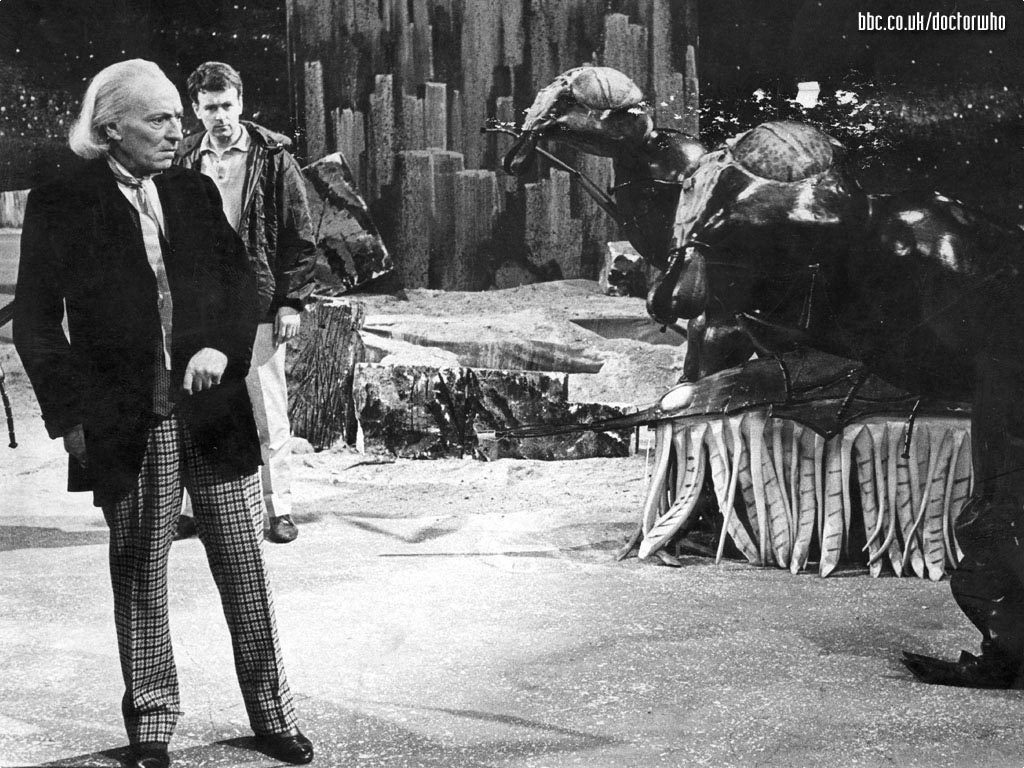
Some of these adventures work – indeed, most do. Some were wild experiments which are ambitious but sadly fall short for me due to the budgetary limitations. Whilst The Daleks’ Master Plan works wonderfully despite its epic scale, the same cannot be said for earlier attempts at this level of ambition such as The Keys of Marinus and The Chase, where multiple sets were demanded for short filming periods, resulting in shoddy-looking set pieces on shoddy-looking scenery. Likewise, ambitious projects like The Web Planet suffer, although that is principally down to the rather formulaic plot underpinning the extremely avant-garde production idea. Again, weak costuming and set design also mean that some of these projects suffer.
 
During his tenure, there was a wide variety of companions, too – again, since there was no tried and tested formula for them, they vary hugely in effectiveness. Whilst Ian, Barbara and Steven are particularly well-rounded, with a variety of idiosyncratic characteristics, others, such as Susan and Dodo sadly end up hitting wide of the mark. The characters themselves were too unreliable, varying wildly from alien school girl to shrieking hindrance in the case of Susan, and from idiotic and pointless white noise to engaging and mature young woman in the case of Dodo. From story to story, these characters were given no solid framework, and each writer took on the role as the script demanded, whether for better or worse. Always present is the boy’s own hero, perfectly embodied by Steven and Ian, and hinted at in Ben’s brief stint with this incarnation. With Hartnell’s health questionable at the best of times, this style of assistant was always needed – someone willing to roll their sleeves up and get physical. The young counterpart to Hartnell’s Doctor should have been perfectly embodied in Susan, a granddaughter of the same heritage with the same character quirks. Sadly, many of the ‘alien’ ideas were lost, and only serials like The Sensorites allow us to fully appreciate how wonderful her character could have been. Her replacement Vicki worked wonderfully, but in turn she was replaced by Dodo, whose very stupidity was so poorly sketched out that she was almost unbearable.

The rarest of companions, though, is Barbara, and it is a role that we will never see again – morally speaking, she is the Doctor’s equal, if not better. She sets him right, and helps to maintain a sense of balance. Jacqueline Hill’s performance in The Aztecs is why it is still one of the greatest Doctor-lite stories, and her ownership of her role in history, and her personal growth throughout, makes her one of my favourite companions ever.

We also have the ‘not-quite’ companions – characters like Katarina, Sara Kingdom and Bret Vyon who briefly travel with the Doctor – and again, it is testimony to Hartnell’s characterisation that at least two of these were shown to mature and grow thanks to his company. Katarina, sadly, was something of a wasted opportunity – but given that the part was originally intended for Vicki, that is unsurprising.

So all in all, with Hartnell we can see greatness – he is not one-dimensional, ever, and provides gravitas and mystery to the role, despite us finding more out about him through his character growth than we ever will with any other incarnation. He grows from his miserly first appearance, through his experiences with his companions, into a loveable, unknowable rogue, able as he is to flit between personas at the drop of a hat. Speaking of hats – on with Troughton...!

Monday, 24 September 2012

The War Machines


And so we reach the end of Season 3, one of the most insanely inconsistent series in the show’s history – and what a way to end.  The War Machines is a pivotal moment in the show – other than Planet of Giants, we’ve not visited the present day before, although of course it will become a standard location in the future.  Whilst this adventure is certainly not the finest, it has some wonderful moments, says farewell to Dodo and welcomes the adorable Ben and Polly into the TARDIS.

From the opening titles, specially commissioned and wonderfully realised in their bold font, we are aware that something unusual is happening – the Doctor and Dodo step out of the TARDIS, seen materialising from a beautiful panning aerial shot, and Hartnell instantly gets goose-bumps – he senses an evil presence nearby, a feeling not unlike that he feels when near the Daleks.  Of course, this is wonderful foreshadowing of a story which is to come in almost a year’s time, but set on the same date as The War Machines.  It utilises the inherent fear we all have of the dangers of modern technology – artificial intelligence now is something of a cliché, but at the time it is bold and new – WOTAN is terrifying precisely because it is incapable of error.

Quite how the Doctor and Dodo manage to infiltrate Post Office tower with such ease is beyond me.  That said, I like that it manages to prevent an awful lot of back-and-forth before we get into the action proper, and takes us straight into the action.  Once inside, the Doctor and his assistant are introduced to Professor Brett and his creation, WOTAN.  An interesting side-note is the pronunciation of WOTAN, as though it started with a V.  WOTAN is an acronym, and yet it is mispronounced by everyone – although, having said that, Wotan is the Germanic name for the Anglo-Saxon equivalent of Odin.  What’s bizarre is how excited Hartnell’s Doctor becomes by this machine, able to ‘think’ and answer a question about 5 times slower than it would have taken to type the question into a calculator.  Also, quite how the computer is able to answer Dodo’s question is unclear – how has it been programmed to know the answer to a question that no-one on Earth should know?!

Dodo’s hypnotism by WOTAN is beautifully played, and wonderfully shot throughout the first two episodes – the director, Michael Ferguson, frames things with flair and style, and there are subtly used effects to hint at the effect the machine has on her.  Jackie Lane is actually rather wonderful here; whilst she has been frustrating in her performance as Dodo in earlier serials, being unconvincing as a young and innocent girl, here, she is unnerving in how adult she suddenly becomes.  The brief audio clip over her scenes in the nightclub, as well as the briefest flicker of the swirling overlay serve to remind the audience of her hypnotism.

Then the action moves to the ‘swinging nightclub’, The Inferno, with Dodo accompanying Brett’s secretary Polly after asking to be taken to “the hottest nightspot in town”, a club filled with people in ‘fab gear’ grooving down to music.  God, it makes me feel old.  But not as old as Hartnell must feel – once he arrives, he is referred to as being dressed like “that disk jockey”, Jimmy Saville.  His introduction to Ben and Polly firmly sets them both in place as the next companions, Michael Craze imbues his characterisation of Ben as courageous, honest and dedicated, whilst Anneke Wills’ beauty is undeniable, and as the “Duchess” she brings class and dignity to the role, whilst also serving the role as a ‘current’ identification figure for the audience in a way that Dodo never could.

The cliff-hanger of episode 1 is one of the most frustrating moments in the show’s history, though, providing no consistency whatsoever – almost as though Ian Stuart Black has never seen the show before, and as WOTAN mutters “Doctor Who is required!” I can’t help but cringe.  It makes no sense at all, and if it were just this once, it would be forgivable – but the name is used for the following three episodes.  Whilst there have always been puns on this name, and in the future we will see him use Germanic variants on this and signing it off with his initial as W, never has it been explicitly stated in a serious context, and it just sits wrong.

Episode 2 introduces the eponymous War Machines of the title – and sadly, they are not as fantastically realised as they could perhaps have been.  Clunky and ungainly, they are not quite the perfect creations WOTAN seems to think they are.  The location scenes, though, where nameless brainwashed men – including Mike Reid – are building up the machines are wonderfully filmed, taken from multiple angles and the depth of field is lovely.  Whilst the machines are made in exceptionally good time, considering the lack of technological advances at the time, I still feel they could perhaps have been a little better designed, made more streamlined.  At times, it seems that the only thing that they can damage is boxes and crates, and that’s by knocking them over whilst trying to turn around.
 
Episode 2 also features the final scenes played by Jackie Lane, and it seems a shame, and rather undignified – her final moments are sat, slouched in a chair, with Hartnell hypnotising her before sending her off to the countryside to recover.  Whilst she has never been a favourite companion, it seems a little unfair that she is so swiftly swept aside in favour of Ben and Polly; in her final serial, we would expect her to take some part in the action, and at least have had a proper farewell scene.  Instead, she gives a great deal of WOTAN’s plot away when the phone rings.  Hartnell’s phone call is a wonderful moment, though, and his gurning in agony is marvellous.  The “special properties” of his ring, mentioned in The Daleks’ Master Plan, are put to use to break Dodo’s treatment, before she is swiftly sent packing.

The scenes with the War Machines at the episode’s end are strange to watch – whilst the testing of the weapon are horrific, using it on a willing volunteer from the manufacturing line, albeit missing him by miles despite his respectable death scene, the scenes in which they text the manoeuvrability of it are bizarre, cutting as they do between film and video, and as such using two different props, with two different numbers – one second we are watching WM9 destroy some crates, then suddenly we’re faced with WM3 ploughing through some boxes, hammer flailing.

Ben’s bravery is the driving force of episode 3 – he willingly walks into danger, hoping to aid the Doctor, and his noble self-sacrifice is terrific.  Likewise, the scenes between Polly and he are great to watch, and the dynamic is lovely; despite her brainwashing, she is able to fight her conditioning to save Ben’s life, demanding that he be spared to join the workforce and then allowing him to escape.  My only issue with this is that Polly is able to fight the hypnotism.  When Krimpton was brainwashed in episode 1, he had a marvellous speech as he grabbed either side of his head, espousing the virtues of humans – “There's nothing more important than human life. Machines cannot govern man!” – before succumbing to the warbling of the machine.  He fought it, yet still lost.  Polly, however, shows no sign of trying to fight it, yet is still able to override her prime directive from WOTAN.

What is magnificent about episode 3, though, is the pre-emptive appearance of the Army, foreshadowing the UNIT family in advance.  The scenes are beautifully shot, utilising clever sleight-of-hand to create an epic feel, using multiple shots of the same truck, and double casting the cast as soldiers.  That said, I am so thankful that this episode exists in its entirety – the entire sequence feels like it goes on forever, and if this were missing from the archive, god knows how this serial would fare – for about ten minutes, all that we can hear are whooshes and booms.  It does, however, all lead up to that magnificent moment, and that infamous cliffhanger, where Hartnell stands, alone, in the face of adversity, and with a War Machine powering down on him.

Episode 4 is fabulous, though – the use of a real newsreader, Kenneth Kendall, delivering the news that all of London should stay indoors, safe, as well as the voiceover of radio presenter Dwight Whylie (the first ever speaking part for a black person in Doctor Who) add a sense of gravitas to proceedings, reminiscent of Orson Welles’ “War of the Worlds” broadcast. 

There are one or two strange moments, but they’re easy to ignore just because this is so much fun – Quite why Brett is still chiming out orders, for instance, when WOTAN’s machines are now built and it is moments away from completion of its mission.  How on earth a War Machine managed to get up to the top floor of the Post Office Tower is another such mystery.  But it doesn’t really matter.  The function of episode 4 is to cement the presence of the new companions, have the Doctor save the day, and for the group to move off – and it does so wonderfully.  Michael Craze is magnificent in his scenes with Hartnell – the way in which he accidentally insults Hartnell for being an old geezer – “a bit past that sort of lark” – is delivered with a wonderfully dry wit, and the Doctor’s reaction is perfect.  Interestingly, the production team managed to get the most out of Craze, also having him provide the voiceover providing the public service announcement telling the public repeatedly to keep off the streets.

But of course, the Doctor does save the day – after capturing a War Machine, he reprogrammes it, and it somehow scales the many floors of the Tower to attack WOTAN.  With the dreadful creation destroyed, all of the pre-programming and hypnotism is broken, and Brett and Polly are back to normal – although the unfortunate Krimpton, who put up such resistance, is killed in the last few moments.  All over the country, the War Machines cease functioning, waiting for a command that will never come.  But as I mentioned earlier, and it is still something which grates on me, there is the lack of farewell to Dodo.  True, she was mildly frustrating in almost every story, fluctuating wildly depending on who was writing for her, and Jackie Lane was hardly the most versatile or polished actress the show has seen.  But for the conditioning to have been broken, and all ‘slaves’ to have returned to their original mental state, we could at least have expected her to return in person to say goodbye to the Doctor.  After she’d thrust herself upon him in The Massacre, she has been through a lot with the old man in his box, and passing on her best wishes via Polly – “She says she's feeling much better and she'd like to stay here in London, and she sends you her love” – seems a little strange.  Still, at least she had the good sense to leave her key with Ben and Polly, and as they race back to the TARDIS and jump in, moments before dematerialisation, my heart skips a beat...

Thursday, 20 September 2012

The Savages

The Savages is another of those much-maligned serials, tragically, since it is, once again, one which is missing in its entirety.  And again, this is a pure travesty.  After the questionable validity of some claims that certain serials are brilliant, but with no evidence either for it or to the contrary, comes yet another lost story which, again, sounds fabulous.  There are one or two moving moments, but overall this is another audio with a few telesnaps. 

The first thing of interest about this serial is the lack of individual episode titles, which is both a good and bad thing – whilst it ensures the audience know exactly what they are watching throughout, and it saves confusion arisen from naming crises such as “which one is The Mutants?”, I can’t help but feel that it takes a dash of the fun out of the thing in future episodes, where we are consciously aware that it’s “a Dalek story!” well in advance of the tin-pot terrors ever turning up.  Having said that, the rise in popularity since the show started pretty much guaranteed to ruin any shock factor anyhow, with the Radio Times often featuring them anyhow, and destroying spoilers.  But more on that in the future – yes, I’m talking about you, dinosaurs!

The incidental music for this serial is simply magnificent, and the use of strings is wonderful – at times majestic, and often contrasted with a fuller, more melodious tune, it is at its most effective during the Savage attack in episode 1.  Throughout, though, Raymond Jones’ score complements the serial beautifully.

The stark contrasts are not just on the score, though, and from what we can tell the differences between Savages and Elders is rather striking – against the quarry backdrop which will become such a trademark of Doctor Who in the future, with some wonderful location filming, the Savages look positively horrific, brandishing their spears with gusto and dressed in their finest cloth bags.  To juxtapose this, the Elders are dressed wonderfully in magnificently luxurious tunics. 

The Elders themselves are fascinating, and bring a new dimension to the mythos of Doctor Who.  These days, we take it for granted too readily that the Doctor is a known entity, the oncoming storm, the predator, or whatever the new series decide to obscurely call him.  Here, though, for the first time, the Doctor and his team arrive somewhere new, and they are known.  Well, the Doctor is, at least.  And far superior to any of his new names, the title bestowed upon him by the elders could not be more fitting – “the Traveller from Beyond Time”.  It is grandiose, mightily powerful.  The scenes of Hartnell’s flattery is wonderfully played, too, with Hartnell playing the coy object of desire wonderfully – of course, it’s all an act, but he plays it with a great deal of conviction, and the audience are genuinely wrong-footed.

My only issue with this serial, really, is the bizarre decision to have Frederick Jaeger black-up for the role.  As far as I can tell, none of the other Elders are wearing black-face – although the photos are grainy and some impossible to interpret, so I may be wrong – and, whilst the working title of the serial was “The White Savages”, and the xenophobia on display here is far more unnerving than that seen in serials like The Daleks and The Ark, there doesn’t seem to be any real reason for it.  The precise reason that this serial works is that, whilst in earlier stories the victims of the racism of others have always ‘looked different’ (whether they be humanoid in contrast with the Daleks or have only one eye and no natural voice box), here, instead, we are faced with racism far more specific – they look exactly the same, save for their clothing.  They hate each other for no reason other than one group lives indoors, with technology, whilst the others are outside, dirty and living in caves.  It’s a far more stark reflection of the sort of persecution seen in World War II than a bunch of Daleks waving their arms around, and far more subtle too.

 The Elders are marvellously performed, too – the naivety and innocence of Robert Sidaway and Kay Patrick as Avon and Flower is wonderful, and again the juxtaposition between their wide-eyed wonder at the magnificence of their lives and the scenes in which the Savages are dragged away begging for their lives is all rather unnerving.  In fact, the entire premise is rather unnerving – the Elders live their grandiose lifestyle simply by absorbing the life essence of the Savages captured from outside the city walls.  What makes it so disturbing, though, is the genuine enjoyment and satisfaction which we can see on the faces of the scientists.  They don’t even realise that they’re the bad guys.  And that’s just so horrific.

 Jackie Lane is given the chance to shine again in this serial, which is great – in episode 2 in particular, Dodo is given some backbone, some panache.  She is, somehow, written as the bright one, able to see through the facade of the Elders and their dirty work.  She also manages to help to bring the mistreatment of the Savages into the open, leading Hartnell to deliver one of his best performances yet.  When given a great actor to come up against, Hartnell thrives, and with Jaeger his scenes are fantastic – the disgust he shows for the experiments are wonderful, and his comparison of the Elders to the Daleks is superb.
The cliffhanger at the end of episode 2 is wonderfully chilling – as “The life force is drawn out of him” – but sadly it brings us back to that issue I have with Season 3;  Hartnell’s relegation.  Finally, last serial, he was back in the foreground, actively leading the serial and shining.  Here, though, as with The Celestial Toymaker and a number of earlier serials, he has been put to one side.  Unlike earlier serials, though, where at least he was treated to a holiday, the poor man is forced to still be present for all rehearsals, and forced to endure the long day of filming – despite not being given one line of dialogue.  Instead, he is rendered catatonic for much of it, occasionally uttering an unnerving moan or groan. 

It does lead into an interesting moment, though – Jaeger’s Jano has Hartnell’s life-force imbued upon him, and within moments, he is impersonating Hartnell’s Doctor, all “hmm”s and “eh”s.  It is an interesting performance – a caricature of the character which we have all come to love.  It is an interesting experiment, too, to see how the production team are able to replace Hartnell.  Whilst we are near the end of the third season, Troughton does not enter until the third serial of the fourth, so Hartnell’s tenure remains, but due to his worsening illness and grouchiness on set, the crew were constantly looking for ways to replace him.  In The Celestial toymaker, they had toyed with the idea of replacing him with another actor once he rematerialised.  Here, though, we are seeing the Doctor’s conscience and soul being transferred into another body.  Fortunately, it was the former idea which stuck, and his regeneration in season 4 is far more tolerable.  Indeed, had they stuck with the idea of having a new actor simply impersonating Hartnell, the series would never have run for nearly 50 years.  It is the very different take which each actor has as the Doctor which keeps the show feeling so fresh and original.  Having said that, it would be lovely to be able to see just how Jaeger changes his posture and mannerisms once Hartnell’s life force has been transferred – allegedly, Hartnell himself spent hours tutoring Jaeger.


 There are some wonderful moments for the Doctor’s companions this week, too – the ideas of using mirrors to deflect the light guns is wonderful, and the escape scene, heading through narrowing tunnels, sounds like it was fantastically claustrophobic to watch.  The way in which Steven and Dodo are able to see the inherent beauty in the Savages’ culture is also lovely, and allows some depth to Dodo in particular.

The final episode is wonderful – Hartnell returns to form, and is excellent as he is proactive; first, stopping the group from murdering Jano on a hunch (one which is later proved correct), he shows his intelligence by reasoning that if they took some of his life force, his very essence, then it stands to reason that he will also have absorbed some of the Doctor’s conscience.  What I love most about this idea is that it cements what we have witnessed over the last 3 seasons; Hartnell’s character has grown, thanks for the most part to his companions.  He has matured, mellowed, and is now far more conscientious than he ever was when we first met him trying to brain a caveman with a rock.  It is this very kindness which saves the outsiders, and brings the culture of the Elders to its knees, although not alone.

It isn’t just this conscience within Jano – the Doctor and his companions force the Elders to stop the experiments by using brute force, destroying the technology which allows the dreadful experiments to occur at all.  It is magnificent – usually looking for peaceful solutions, hearing Hartnell swinging into computer monitors and vats of bubbling liquids is great, and then the others join in too!

Ultimately, though, we reach the end – not only of this serial, but of the Doctor’s acquaintance with one of his finest companions, Steven.  It is a fitting end for Purves, though – after months of proving his versatility as a performer, he has also shown a wide variety of nuances of his character too.  From slapstick comedy to singing, from well-meaning moraliser to angry wanton destruction, Steven covers every trope a companion should with great aplomb, and for him to be left here, on this nameless planet, helping to create a truce between the two factions, seems fitting.  The farewell is emotional, as Jackie Lane again shows the potential of her character as she bids a fond farewell to him.  But it is Hartnell who once again steals the scene – firstly assuring him that he is “ready for this task”, and then soon after uttering the touching accolade “I’m very proud of you”.  It is a moving, and bittersweet moment, and Steven’s character arc is brought to a close wonderfully – from his origins in The Chase as prisoner of the Mechonoids, he was rescued from a desolate planet, and he has now been returned to one, this time with the power to change it for the better using all he has learnt from the Doctor.

 And so, The Savages and the Elders are united, and the Doctor and Dodo head off across the barren wastelands and back to the TARDIS, ready for whatever awaits them...

Sunday, 16 September 2012

The Gunfighters


It seems fitting that I’ve reached The Gunfighters just in time for the new episode of the new series, A Town Called Mercy, which sees the 11th incarnation of the Doctor returning to the Wild West.  As I mentioned in my last blog, for The Celestial Toymaker, this serial was, for many many years regarded as the worst Doctor Who ever made.  In that same blog, I refuted the claims of Loficier and Haining, saying that what they saw as an absolute gem was actually pretty appalling – and here, I’ll do the exact opposite.  Whilst it isn’t my favourite Doctor Who ever, by any means, The Gunfighters is certainly not the worst serial ever produced – it isn’t even the worst of Hartnell’s tenure.  In fact, it’s a delight.

Seriously – it is.  For one thing, from the very opening, it has Hartnell back centre stage.  After weeks and weeks of gradually being written out by the former production team, and being sidelined for no perceivable reason, he is back in the spotlight, and fortunately the serial plays to his greatest strength – comedy.  And this is a comedy.  A really, really funny one.  It was unfairly referred to as Talbot Rothwell comedy at best – but having said that, Rothwell is responsible for what was voted the greatest one-liner of all time, so that isn’t really a put-down either.  Hartnell is rarely better than when he has some juicy and hilarious dialogue, and here, Cotton has provided joke after joke for his deadpan delivery.  He isn’t his giggling self here – he’s delivering zingers, turbo-charged with comedy – “Doc Holliday's a great friend of mine. He gave me a gun, he extracted my tooth. Good gracious me, what more do you want?” is a wonderful line – and so here we have him at his best.

What’s more, Purves too thrives on the chance to do comedy again.  After his first appearance in the series as Morton back in The Chase, it’s great fun to see him doing his speedy double takes and eye rolling.  Even better than Purves, though, is Jackie Lane as Dodo – for the first time, she’s proactive and engaged in a storyline, not feeling like a useless spare part.  She shines in this serial – sadly it was evidently too little too late, and she’d already been told that she was to be removed within the next two storylines.

The use of the Ballad of the Last Chance Saloon is deemed by many to be the principal shortcoming for this serial, but I think that’s somewhat missing the point – whilst it is invasive, and impossible to get out of your head for days afterwards, it works in the context of this story precisely for those reasons.  This season was a completely mixed bag, an eclectic mix of styles which kept the show feeling fresh week on week.  Here, Cotton uses the ballad as a framing device for each and every important scene – for the first two episodes, it is Cotton’s arrangement, using similar phrasing and tempo, but then Rex Tucker, the director, uses it in episodes 3 and 4 to even greater effect, using it as a summative device, reflecting all that we see on screen.  It is bold and clever, and whilst it may distract slightly from the action, causing the audience to be aware that what they are watching is only a television programme, I think it serves its function perfectly.

The set design is stunning too – whilst the new series had the benefit of visiting a location in Spain for filming (the same set used by Sergio Leone, in fact, for many of his films), here, the crew have made do with a studio in London, and yet it still feels epic.  The use of props attached to painted cycloramas really helps to create a sense of depth, as does the use of live horses and props to really sell the idea that this could be anywhere in America.  Tucker, as director, has worked wonders too, mixing high angle crane shots with interesting shots taken through scenery, we can really believe in this location.  The costumes, too, are stunning, and the makeup department have done a wonderful job with the huge amount of facial hair on display.

Steven and Dodo’s excitement at arriving in the Midwest is brilliant – and their changing into apt clothing before swinging guns and nearly shooting their own feet off is fantastically funny – as is Wyatt Earp’s putdown to Steven who, when he confesses he isn’t a real gunslinger, mutters “You did kinda make that look obvious didn't ya, boy?”  Likewise providing me with some geeky entertainment was the assumed names the Doctor gives for the travellers, specifically naming himself after Doctor Caligari, the villain in one of my favourite pieces of abstract cinema from the 1920s.


One of the finest scenes in this serial is the moment in the dentist’s office, with Hartnell and Anthony Jacobs playing wonderfully off each other – the dialogue is rich and luxurious, and dripping with wit, as Hartnell claims he never touches alcohol, but Jacobs’ Doc Holliday assuring him that he does, before taking a quick snifter of liquor.  The end shot of this scene, with Hartnell gurning in displeasure as Jacobs looms into shot with the pliers is brilliant.

The episode ends with Purves and Lane being forced – at gunpoint – to entertain the Clanton brothers with their own rendition of the Ballad of the Last Chance Saloon, once again proving Purves to be a man of many talents.  His comedy double-take as he starts to lose focus, before spotting the gun pointed at his stomach is brilliant, and he belts the song out all the louder to keep the gunman happy.

Indeed, the only real fault I can see in the entire production is the casting of the Clantons and their crew– whilst Shane Rimmer shines as Seth Harper, the others from the group vary from average to appalling, sometimes in one sentence.  William Hurndell, in particular, has the most sporadic attempt at an accent heard so far in the show.  Episode 2 sees the ballad continue – although this time the performer is Kate, Holliday’s beau, who for some reason mimes it dreadfully.  It seems like an odd casting choice, since the fact that she is a barroom singer is integral to the characterisation, to have cast a woman who evidently was incapable of singing.

Hartnell continues to impress as he has staggered down the street, face drawn out in agony following the tooth extraction and looking rather glumly at the gun which Holliday foisted upon him in episode 1.  His arrival in the bar, believing that he has made friends and suspecting no ulterior motive, is great, as is his accidental shooting of Seth’s gun out of his wrist.  His dismissal of being “the great Doc” is fantastic too, as he assures them that he is “reasonably accomplished, but not great”.

A lovely side-note is that this episode was the first connection that one Matthew Jacobs ever had with the show – he was the son of Anthony, playing Doc Holliday, and was given the task of opening and closing a panel in the saloon for one of the cameras – some 30 years later, he would go on to write the script for the movie, featuring Paul McGann.

The episode ends with the rather disturbing scene of Steven being collected by a lynch mob, with the Clantons insisting that the Doctor leave the safety of the prison, before Steven is hung instead.  We are even treated to the sight of Purves with a noose around his neck – although not for long, so as not to disturb children watching.  The reprise of this in episode 3 also features a lovely moment of realism, as the girls and women from the crowd are ushered away by the men, so that they don’t have to witness the murder.

Episode 3, in fact, is my favourite of this whole serial – the tension is becoming ratcheted higher and higher, as the story makes its way to its inevitable conclusion, and the gunfight at the OK Corral.  Admittedly, there are inaccuracies abound as far as actual history goes – the people involved are almost certainly not all the actual participants of the fight, but each character is drawn nicely, and the tension is palpable.  Many of the inaccuracies actual come from films made at the time, and so the audience would probably not have known any different.   

What massively helps to sell the inevitable gunfight is the arrival of Johnny Ringo, the titular character of this episode.  Whilst his accent is miles off, Laurence Payne oozes charm and danger, and his first scene, which seems him be recognised by Charlie the Barman and, as such, executing him in cold blood, is genuinely menacing, and the lingering shot on Charlie’s corpse, spread across the bar, is moving. 

My favourite moment of episode 3 is with Jackie Lane and Jacobs – having kidnapped Dodo, Doc Holliday has put them up in a gambling den in a near-by town.  Desperate to return to the TARDIS and the Doctor and Steven, she pulls a gun on Holliday, and the performance is smashing – by far her best in her entire time with the Doctor.  The look of determination on her face is juxtaposed wonderfully with her apology for pointing the gun between his eyes, and after he agrees, her near-faint and request for water is great – as is Holliday’s acquiescence. 

The fourth episode has some oddities about it, too – going against everything the Doctor has ever told his companions, he attempts to intervene and change history.  Considering that even Dodo and Steven know about Wyatt Earp and Johnny Ringo, and that the Doctor reacted so strangely to the mention of the Clantons back at the start of this serial, it proves that this event is too well-known to be meddled in – yet the Doctor actively tries to dissuade either side from engaging in battle. 

The fourth episode pulls exactly the same trick on the audience as Cotton’s last script did – after almost an hour and a half of laugh-out-loud comedy, the jokes purposefully dry up, and we’re left with a bitter taste in our mouths.  The final showdown at the OK Corral looks incredible, shot on film and with some wonderful camera angles, again making use of the crane-mounted camera, and taking in the glorious set design.  Whilst the arrival of the Clantons sees Lynda Baron’s ballad performed with an upbeat tempo, it gradually declines into a far more sombre affair, as people are shot left, right and centre, with a grim sense of realism. 

The final sweeping shot of the battle, which sees Clanton corpses littering the streets, before coming to a stop at the feet of the two Earp’s and Holliday, is beautifully filmed, and the stark contrast between the bodies, the dark trousers, and the sun-bleached sand is magnificent.

All in all, then, this remains a firm favourite of mine – perhaps not in my top ten, but one I’ll happily rewatch over and over.  Yes, the ballad haunts me for days (I’m humming it now).  Yes, the performances aren’t magnificent from some of the supporting cast.  But what it does do is allows Hartnell to become the main character again, showcases Purves’ skills again as a comedian as well as a singer, and (for once) allows Jackie Lane to shine too.  Added to that the excellent set and direction, and the belly-laughs to boot, and this is certainly not deserving of the unfair title of worst serial ever.  I could name two worse, and we’re not even at the end of season 3.