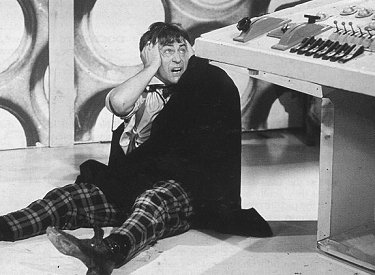
The Evil of the Daleks
is widely considered one of the best serials ever made during the classic
run. According to Wikipedia, it was
voted the best ever serial in a poll held by Dreamwatch for the 30th
anniversary. But why? What is
it about this particular story that makes it so good? Bear in mind that in
1993, when the poll was held, the episode had not existed in any visual format
for years. Indeed, only one episode from
this serial exists now, discovered in 1987, 6 years before the 30th
anniversary. The originals had been
wiped in the late 60s, meaning that unless you saw it on original broadcast,
chances were you’d missed it. The
novelisation was released in 1993, not long after the vote, and was in fact the
very last serial to be novelised, with the exceptions of the Adams stories,
such as City of Death.
So what is it, then, that makes this such a popular
serial? It has everything we’d want from
an outstanding story; Daleks? Check. New
companion? Check. A race through time and space? Check. Genetic testing?
Check. But all of these are not what
makes The Evil of the Daleks such a
phenomenal serial. No, that honour
solely comes down to Troughton – here, we finally can see the Doctor is back on
form. Rather than winning by chance, or
coming to some final negotiations to prevent a war, or having to be saved by the
proactive nature of his companions, here he is the Time Lord Victorious that we
have come to expect. He is forward
thinking, proactive, dynamic, funny, warm, compassionate, and, most of all,
brave. This serial comes at the end of
the fourth season, which has seen Hartnell leave, the last vestiges of his
tenure have finally been shaken off with the departure of Ben and Polly in the
last episode, and the TARDIS team are now finally free to reinvent
themselves.
Thankfully, Terry Nation was unable to write for this serial
– designed to be the final face-off with the Daleks, as Nation was trying to
break USA with the Doctor’s nemesis – and so David Whitaker was brought
in. Whitaker had previously written for
Troughton’s Doctor, and the Daleks, in The
Power of the Daleks, arguably one of the finest Dalek stories to date. In
addition to that, it allows Troughton and Hines to perfect the double act
between the two which we saw the beginnings of in The Faceless Ones. Here, the
two are given the chance to gel perfectly, honing their relationship, before
adding into the mix Victoria Waterfield, soon to be the newest companion. Of course, this is another difficult one to
watch and analyse effectively, as most of it is missing. Much of it does exist in telesnap form,
though, and the photo-novel is published on the BBC website. Reading through this whilst listening to the
audio track helps to gain some appreciation for how wonderful this serial is,
though.
 We are thrust straight into the action at the top of episode
1, with the Doctor and Jamie still in hot pursuit of the TARDIS following the final
scene of The Faceless Ones. Like Sherlock and Watson, the pair unravel
clues and track the ship down – starting with a wonderfully comedic scene as
the Doctor and Jamie have to interview an employee of the airport, before being
handed a note saying that the TARDIS was due to be collected at 3pm, and signed
for by J. Smith – possibly a little nod to the Doctor’s alter-ego, John Smith,
although he hasn’t used that moniker yet.
That’s the trouble with time travel, of course, where things never
happen in quite the right order. Troughton’s
Doctor is first given the name John Smith in The Wheel in Space, which was also co-written by David Whitaker.
We are thrust straight into the action at the top of episode
1, with the Doctor and Jamie still in hot pursuit of the TARDIS following the final
scene of The Faceless Ones. Like Sherlock and Watson, the pair unravel
clues and track the ship down – starting with a wonderfully comedic scene as
the Doctor and Jamie have to interview an employee of the airport, before being
handed a note saying that the TARDIS was due to be collected at 3pm, and signed
for by J. Smith – possibly a little nod to the Doctor’s alter-ego, John Smith,
although he hasn’t used that moniker yet.
That’s the trouble with time travel, of course, where things never
happen in quite the right order. Troughton’s
Doctor is first given the name John Smith in The Wheel in Space, which was also co-written by David Whitaker.
Of course, all is not as it seems, and the TARDIS crew are
being monitored by a man in a nearby field, listening in on their conversation
via a wireless radio. As it turns out,
though, no one is quite who they seem, and the Doctor and Jamie end up
following their source, whilst being tailed by a man named Kennedy. Kennedy is in contact with a man called Waterfield,
played with sympathetic gusto by John Bailey.
What is fascinating is the way in which these two storylines are running
in tandem, with small connections throughout.
The Doctor and Jamie soldier on unravelling clues, whilst we get to see
Bailey’s Waterfield working away, suspiciously out of his own time. His costume is decidedly Victorian, as is his
speech pattern. There’s a lilting rhythm
to his dialogue, and we cannot help but feel comfortable in his presence. That is, of course, ironic, since he is ultimately
involved in the scheming and as such should not
be trusted. Waterfield’s suspicious
origins become more and more intriguing as we see him visited by a gentleman
named Perry who comments on antique furniture, which is in mint condition, as
though it were brand new.
The Doctor and Jamie arrive outside a warehouse, whilst
inside Hall, refusing to be involved in a kidnapping plot, is beaten
unconscious by Kennedy. The time travellers
enter in time to find him laid out across a vast sum of money, mumbling a
name. The detective work continues as
the Doctor manages to deduce characteristics and mannerisms about the attacker
from a book of matches, before the pair set off, watched by Kennedy. Kennedy is played with sleazy relish by
Griffith Davies, and the scenes between him and Waterfield that follow are
wonderful. The ease with which Kennedy
talks about beating up Hall and the like makes him horrifically unknowable,
calculating and murderous in equal measure.
Watching as he spies on Waterfield from outside the room is unnerving,
too; this man has no moral compass, no honesty or decency within him. Waterfield, meanwhile, continues to lead the
Doctor and Jamie on a merry dance, as he uses photos of the two to send Perry
to talk to them. The multilayered scheme
comes across as confusing and convoluted, but works on every level simply
because it is so brazen.

There’s a smashing moment in the café, as the Doctor and
Jamie sit listening to The Seekers, where they discuss the fact that they are
conscious that they are being toyed with – there is no company by the name
signed on the delivery order, according to the phone book, and he says that if
only they knew who their enemies were, the Doctor could deal with the
situation. When Jamie asks if it is
still the Chameleons responsible, the Doctor responds that it is “something else. I can feel them, closing
in all around us.” This psychic sense is
a call-back to a throwaway line in The
War Machines, during which Hartnell’s Doctor noted that he sensed his
nemeses, the Daleks. At the time, of
course, it was a theory discounted due to the presence of the eponymous War
Machines themselves; but bearing in mind we now know of the time frame in which
this story, as well as the previous one and Ben and Polly’s first ever
adventure, is set, it becomes all the more interesting to think that the Doctor,
back then, noted that the Daleks were around at the same time. Likewise, when Perry arrives and hands the
Doctor a business card, intended for Doctor Galloway and Mr McCrimmon, he
announces that it is Mr Waterfield who is expecting him – the true person
behind the scheme is revealed, yet still shrouded in secrecy and cunning.
The episode rattles towards the first cliffhanger at a great
pace, as Kennedy attempts to break into the secret room at the back of
Waterfield’s office, a room filled with technologically advanced machinery
which has no place in 1966. Of course,
what makes this all the more unsettling is the fact that this machinery, which
has no place in 1966, is in a room belonging to a man that has no place being
in 1966. It is an incredibly clever
scenario, one which completely throws the audience. The emergence of the Dalek in the final
moments, uttering “Who are you? Answer!” is horribly unnerving, and despite
their presence in the title – spoilers, damn it! – we almost forget that they
are supposed to have been involved.

Episode two, thankfully, exists, so once again we are given
the opportunity to relish Derek Martinus’ direction. Whilst most of his work is missing, from the existent
episodes of his work still available, we can tell that Martinus is a gifted
director – his work on Spearhead from
Space, the very first colour serial, is
simply breathtaking, as is his work on The
Ice Warriors and The Tenth Planet,
so we know that such a strong script is in suitably skilled hands. The materialisation scenes are wonderfully
shot, and again the deep-focus is used perfectly, particularly in an early
scene to enhance the comedy in the double act of the Doctor and Jamie – as he
warns Jamie not to be clumsy, moments before knocking a vase off to be caught
by Jamie behind, who gives an over-the-top eye roll before resetting it on the
worktop. Moments like this are
magnificent when we are able to see them, and we can only imagine what the rest
of this looks like. The scenes in
Waterfield’s shop are wonderful – from the Doctor and Jamie continuing on their
Sherlock-and-Watson double-act and discovering Kennedy’s body, and Jamie’s
utter lack of subtlety, to the scenes with Perry fetching the Police Officer,
so utterly trusting – and the direction simply works. There’s a bizarre Star Wars-esque screen wipe
as we cut from Troughton’s face in close-up to a copy of the photograph Perry
had earlier on being placed into a trap by Waterfield.

Waterfield is a wonderful narrative construct, and he is
played with perfection by Bailey – being able to see him in this episode allows
us to better appreciate his performance throughout the serial. He truly is a man torn, stuck between a rock
and a hard place. His wish to hand
himself to the authorities in a few episode’s time becomes more relatable
having seen him here, in mental anguish as he struggles with the right and the
wrong of his actions; he desperately wants his daughter back, but the death of
Kennedy makes him realise that there is more to the Daleks than at first there
appears to be.
What Whitaker does so magnificently with his script, though,
is to confuse us. Still, more than half
way through the second episode, we’ve only seen the Daleks briefly, and whilst
they have committed murder onscreen, their plans are still an utter
mystery. It all seems so ridiculously
convoluted, with the Doctor and Jamie following clue after clue – many of them
utterly redundant anyway – to get them into the back room of a Victorian
antique specialist’s shop in 1966, where they are then transported back to
1866, only for them to still remain in the background, using humans to complete
their work as they become babysitters for Deborah Watling’s Victoria
Waterfield. Watling gets an unfair level
of criticism, I feel, principally due to her being the companion instead of
Pauline Collins’ character from The
Faceless Ones, who would have been a more contemporary identification
figure. Instead, Victoria, as a
character, comes across as more of a damp squib, a Victorian girl terrified by
almost everything she sees. Here,
though, she is surprisingly confident, never screaming or even really
whimpering. There is fear evident in her
eyes, but she follows the instructions of the Daleks to the letter, and simply
bides her time, confident that she will be rescued, somehow.
Troughton’s Doctor is magnificent in the early scenes in
Maxtible’s laboratory, and Goring’s pride is wonderfully contrasted with
Troughton’s seemingly bumbling silliness.
What is telling, though, is that moment that we hear mention of “Static”,
and Troughton’s instant about-face. He
goes from impish clown to serious scientist in a heartbeat, as he realises the
implications of the static electricity, and who is therefore responsible for
the manipulative games at hand. Whitaker
here continues the ideas originally set out in Terry Nation’s earliest Dalek
stories, and sketches the creatures as Nazi despots, horrifically single-minded
in their desperation for what they see as the purity of all civilisation; the
mention of testing on humans is enough to make anyone shudder, and that it
should be Jamie who is to be tested upon is all the more shocking.

With Jamie finally waking up in the drawing room, we see
more of the lover, as well as the fighter, from The Faceless Ones that we have come to expect; he flirts
outrageously with Molly, the serving girl, as well as with Ruth Maxtible to
some extent, and is instantly drawn to the portrait hanging above the
fireplace. Quite why Maxtible has a
portrait of Waterfield’s wife is never made entirely clear, but this slight
oddity can easily be overlooked. The
episode ends with a stranger in the window striding forward, knocking Jamie unconscious
with a cosh before planting the unconscious Molly in his seat and leaving. Meanwhile, two Daleks chant in abrasive tones
that there will be no delay to their plan to test on Jamie.
Episodes 3 and 4 are sadly where things seem to go a little
wayward for me during The Evil of the
Daleks. Obviously, in a 7 episode
serial we come to expect a little filler, but there are entire sequences here
which seem utterly irrelevant, and are particularly difficult to sit through
with no visual aid. Firstly, we have the
discovery of the maid, unconscious, and the Doctor follows a clue – a piece of
straw – to the outhouses, where Jamie has been taken by Toby, the burly
stranger from the previous episode.
Here, it appears he is under the employment of one James Terrall, fiancé
of Ruth Maxtible. Terrall swiftly succumbs
to some form of interference, though, and becomes an entirely different
person. Toby insists that Terrall
offered to pay him substantially for the kidnapping of Jamie, but Terrall
denies this stringently, and the thug attempts to blackmail him in a later
scene, leading us into the cliffhanger which is a direct reprise of the end of
episode 1 – the thug in question this time is Toby, rather than Kennedy, but
his fate is the same. The Doctor’s following
of the clue to the outhouses is utterly pointless, since Jamie is freed by
Terrall anyhow. Likewise, Terrall’s
motives for asking Toby to kidnap Jamie in the first place are unclear, and we
never gain any closure from it – with Toby’s death, so too does the story. All in all, it seems like a redundant
sidestep in the action; although well acted, and well scripted too, it adds
nothing to the plot.

Whilst all of this is going on, there is also a bizarre
sequence in which we meet Kemel, Maxtible’s Turk slave, played by Sonny
Caldinez in his first Doctor Who appearance. Caldinez will go on to appear in four further
serials, each time playing an Ice Warrior.
He is a mountain of a man, an impressively built man in fact, and the
first scene featuring him with Maxtible is entirely set up for the scenes to
follow in the opening scene of episode 4.
Here, though, it all seems a little perfunctory. Simply by looking at him, we can tell that he
is a monstrously strong character, so the scenes in which we see him shatter
planks of wood with his bare hands, or bend iron rods around his neck in an
attempt to prove his strength to the watching Dalek, all seem rather
pointless. Likewise, the explanations
about the danger of the spikes and so on; ultimately, we could simply have seen
Jamie become almost impaled, and that would have been just as effective. Kemel
is another of those stock characters that Doctor
Who does so well, but which will from here on gradually dwindle in
frequency; the gigantic racial stereotype, who seems all brawn and no brains
but which shows compassion and humanity.
This is epitomised by Toberman in the very next serial, The Tomb of the Cyberman, but here seems
to be being trialled.
Really, episode 3 – and 4, and much of 5 too – is all set up
for, and completion of, the experiment.
Jamie is being tested for the Doctor to extract ‘the human factor’ as
Jamie is monitored completing a number of tasks, ultimately saving Victoria
Waterfield from her captors. What is
particularly interesting here is that the Doctor comes across as manipulative;
Sylvester McCoy is regarded – rightly – as having created the “Darker Doctor”,
a more manipulative and devious character who plots and plans and uses everyone
for his own ends. He has a game plan,
and knows where everything is heading.
This is most notable in his final season, in serials such as Ghost Light and The Curse of Fenric. But
this is proto-McCoy. Here, Troughton
intentionally baits Jamie into heading off to do the righteous thing and to
save the girl, all the time using him for his own ends. The heated argument between Troughton and
Hines is horrible to watch – our Doctor and our Jamie, at each others’ throats,
makes for uncomfortable viewing indeed.
 n episode 4, we have a fight sequence which seems to last
forever; whilst it all sounds great, it’s difficult to tell exactly what is
happening without Hines’ exuberant linking narrative. Eventually, however, through Jamie showing
compassion and mercy to Kemel, the fight comes to an end and the two make an
uneasy truce; one which is later solidified.
There is what sounds like a hilarious scene in which a Dalek enters with
Victoria’s lace handkerchief, laying it down in position for a trap. The image of a Dalek with something as
innocent and feminine as a lace hankie makes me giggle. Whilst Jamie’s quest continues, we have
scenes intercut with the Doctor in the laboratory, monitoring his progress and
gradually distilling chemicals based on what he watches. Exactly what or how this is done is unclear –
which chemical exactly will help to imbue compassion within a Dalek?! – but it
is often better not to look too closely at the science of Doctor Who, at least not until Christopher Bidmead joins the staff.
n episode 4, we have a fight sequence which seems to last
forever; whilst it all sounds great, it’s difficult to tell exactly what is
happening without Hines’ exuberant linking narrative. Eventually, however, through Jamie showing
compassion and mercy to Kemel, the fight comes to an end and the two make an
uneasy truce; one which is later solidified.
There is what sounds like a hilarious scene in which a Dalek enters with
Victoria’s lace handkerchief, laying it down in position for a trap. The image of a Dalek with something as
innocent and feminine as a lace hankie makes me giggle. Whilst Jamie’s quest continues, we have
scenes intercut with the Doctor in the laboratory, monitoring his progress and
gradually distilling chemicals based on what he watches. Exactly what or how this is done is unclear –
which chemical exactly will help to imbue compassion within a Dalek?! – but it
is often better not to look too closely at the science of Doctor Who, at least not until Christopher Bidmead joins the staff.
The scenes in which the Doctor extols of the virtues of
compassion is quite an interesting one, particularly as it is juxtaposed with a
wonderful scene between Maxtible and Waterfield, in which Maxtible shows that,
like the Daleks, he too is missing that vital ingredient in the ‘human factor’
the Daleks are so desperate for.
Gradually, episode by episode, Maxtible is revealing himself to be more
and more insane in his hunger for wealth.
Still, during episode 4, we don’t even know why he is working with the
Daleks. It is the ultimate slow burn, forcing
the audience to question the motives of this man. Waterfield shows regret, remorse, sympathy
for the victims in all this – including himself, of course – and yet in
contrast, Maxtible feels nothing but overwhelming self-assurance and pride in
his experiments and his laboratory.
There’s a chilling scene at the end of this episode between Maxtible and
a Dalek in which Maxtible, under no circumstances, uses the word “obey”. He argues that they are mutually exclusive
business partners, and they are assisting each other in their experiments. But under no circumstances is he, Theodore
Maxtible, the servant of the Daleks! As
he says, “You have a strange way of
putting things. I prefer to say that you have asked for certain services, I
have provided those services punctually and efficiently.” When the Daleks commands that he obey for the
third time, his response is a pointed “I understand”.

Finally, after the cliffhanger at the end of episode 4
seeing Kemel and Jamie coming face to face with a Dalek in the banqueting hall
where Victoria is being held, we get to see Jamie and Victoria meet. The scene at the beginning of part 5, where
the pair throw their rope over the Dalek before propelling him over the edge of
the balcony sounds wonderful, and probably looked it too. Victoria then reinforces the relationship
that the mute Kemel had suggested exists between them, and the pair are
evidently close, but what is even more evident is that there is a definite
chemistry between Hines and Watling; the pair hit it off instantly, and it
speaks volumes of their relationship that the pair are still close today,
appearing in documentaries and on conventions together, the two are inseparable. The trio then barricade themselves in the
room, as the experiment comes to an end.
In the laboratory, the Doctor has finally gathered enough evidence and
samples to create the elusive ‘human factor’.
There is a wonderful moment during which Troughton’s Doctor refers to
himself as a “Professor of a far wider academy”, and following the scenes in
episode 4 during which he tinkers and smiles with glee as Jamie’s life is
endangered, we almost get a sense that the Doctor would quite enjoy being able
to test future companions in such a way.
Indeed, it perhaps goes some way to explain Hines’ presence as the
longest running companion; he more than proves his worth many times over.
 Meanwhile, we have further evidence of Maxtible’s lack of
compassion and humanity in his scenes with Waterfield – after threatening to
kill him in the previous episode, and being prevented only by Terrall’s sudden
appearance, the two continue to argue about the morality of their experiment. Contrasting with these scenes, we have the
moment when Terrall kidnaps Victoria via a secret passage and ends up in a
sword fight with Jamie. Again, it sounds
wonderful, but it is ultimately more filler, not adding anything to the
plot. Terrall isn’t in charge of his own
faculties, so it hardly works as a criticism of humanity in the same way as
Maxtible’s inhumanity does. The same
goes for Terrall’s mistreatment of Molly earlier on; whilst Maxtible is
choosing to do inhuman things for his own reasons – the acquisition of the
secret of turning base metals to gold – Terrall is being controlled, and so is
ultimately just a monster in the same way as the Robomen of The Dalek Invasion of Earth.
Meanwhile, we have further evidence of Maxtible’s lack of
compassion and humanity in his scenes with Waterfield – after threatening to
kill him in the previous episode, and being prevented only by Terrall’s sudden
appearance, the two continue to argue about the morality of their experiment. Contrasting with these scenes, we have the
moment when Terrall kidnaps Victoria via a secret passage and ends up in a
sword fight with Jamie. Again, it sounds
wonderful, but it is ultimately more filler, not adding anything to the
plot. Terrall isn’t in charge of his own
faculties, so it hardly works as a criticism of humanity in the same way as
Maxtible’s inhumanity does. The same
goes for Terrall’s mistreatment of Molly earlier on; whilst Maxtible is
choosing to do inhuman things for his own reasons – the acquisition of the
secret of turning base metals to gold – Terrall is being controlled, and so is
ultimately just a monster in the same way as the Robomen of The Dalek Invasion of Earth.
Waterfield’s humanity and conscience leads to one of the
most telling moments for Troughton’s Doctor we have yet seen, continuing the
idea that he is being manipulative, and providing us with a moment of
troublesome foreshadowing; as Waterfield talks about the “destruction of a
whole race” due to their meddling, he is meaning that if the Daleks were to
acquire the ‘human factor’, it would make them utterly unstoppable. The Doctor’s response, however, has far
darker connotations, as he mutters “I don’t think you quite know what you’re
saying, but yes.” Here, the Doctor is
making perfectly clear that he intends to destroy the Dalek race. We will not see such an ethical dilemma
involving the Daleks until Tom Baker’s infamous “Have I the right?” speech in Genesis of the Daleks. There’s a terrifying moment where Waterfield
even contemplates murdering the Doctor – now of course he wouldn’t, and indeed
couldn’t, do that; he’s the moral compass in this right now. Maxtible raising an axe behind Waterfield in
the last episode was believable, because he comes across as a person willing to
commit atrocities for his own ends.
Waterfield, though, is too good, and pure, and innocent.
The cliffhanger is truly unnerving, though, as we see the
humanised Daleks running amok, taking the Doctor for a ride and generally
acting in a silly and bizarre manner.
Really, this shouldn’t work as a cliffhanger; Maxtible muttering “an
amusing little game, eh, Jamie?” isn’t a moment of mortal peril. No-one is in danger here; rather they’re all
messing about and having fun. The
beginning of episode 6 is equally frivolous, with scenes of the Daleks chanting
the word “trains” in their grinding grating timbre, and playing roundabouts and
chanting “dizzy” is all a little disconcerting.
In hindsight, this is the pivotal moment that brings about the Daleks’ “final
end”, but for now it just sits strangely.
Similarly, the Doctor naming the Daleks is uncomfortable – for such
human things as names to be associated with such inhuman creatures as the
Daleks makes an audience uncomfortable.
But that’s sort of what Whitaker is going for here; when we instil the ‘human
factor’ into a Dalek, it seemingly utterly removes the ‘Dalek factor’ itself,
leaving the creatures as petulant children, pouting and asking why before
stomping their foot and going to their room.
 The destruction of Maxtible’s laboratory, as everyone is
taken via the time machine to Skaro, sounds terrifically bombastic, and no
doubt looked phenomenal. The sound of
horror in Goring’s voice as Maxtible realises that his entire life’s work is
about to be destroyed is awful; what makes it all the more disturbing is that
it again allows us to draw parallels between Maxtible and the Daleks. His daughter, Ruth, has run away with Molly
and Terrall – no longer under the influence of the mind-controlling technology –
and yet he is utterly unfazed by it, as his true child, his baby, is his
laboratory. So too do we see this in the
final scenes of episode 6 reflected in the Emperor Dalek, whose willingness to
sacrifice the 3 human-Daleks is chilling.
Whilst on Skaro, Maxtible’s self-confidence and misguided surefootedness
continues to baffle, as he insists that “No-one can help you – no-one but me!”
he remains blinded to the truth.
Ultimately, although the alchemical secret is given to him, he can do
nothing with it. Instead, he is stranded
on an alien planet, utterly insane and infused with the Dalek Factor. There is a chilling moment in episode 7
where, once converted, he responds with the phase “Obey”, proving once and for
all that the last vestiges of what made him human are now gone forever.
The destruction of Maxtible’s laboratory, as everyone is
taken via the time machine to Skaro, sounds terrifically bombastic, and no
doubt looked phenomenal. The sound of
horror in Goring’s voice as Maxtible realises that his entire life’s work is
about to be destroyed is awful; what makes it all the more disturbing is that
it again allows us to draw parallels between Maxtible and the Daleks. His daughter, Ruth, has run away with Molly
and Terrall – no longer under the influence of the mind-controlling technology –
and yet he is utterly unfazed by it, as his true child, his baby, is his
laboratory. So too do we see this in the
final scenes of episode 6 reflected in the Emperor Dalek, whose willingness to
sacrifice the 3 human-Daleks is chilling.
Whilst on Skaro, Maxtible’s self-confidence and misguided surefootedness
continues to baffle, as he insists that “No-one can help you – no-one but me!”
he remains blinded to the truth.
Ultimately, although the alchemical secret is given to him, he can do
nothing with it. Instead, he is stranded
on an alien planet, utterly insane and infused with the Dalek Factor. There is a chilling moment in episode 7
where, once converted, he responds with the phase “Obey”, proving once and for
all that the last vestiges of what made him human are now gone forever.
The Emperor Dalek itself is simply magnificent, sitting
astride a magnificent dais as it is, looming over the Doctor and the other
Daleks, tentacle-like wires and pipes coiled around it. The voice, too, is horrifying – it almost
seems more human than other Daleks, capable of cunning and malicious cognitive
processes as it is. The Emperor Dalek
ultimately reveals the real plan – all along, the Doctor’s experiments have
been a shroud, a red herring to allow the Daleks to monitor what it is exactly
that makes humans tick so that they can then distil the ‘Dalek Factor’. The cliffhanger at the end of episode 6 is
hauntingly cried out by the Emperor; “You will take the Dalek Factor, and you
will spread it throughout the entire history of Earth!” Whilst the Doctor has been tinkering away, he
has unwittingly allowed the Daleks the ultimate weapon, one which will turn
every human being, ever, into a Dalek.
Victoria finally gets the chance to step up to the fore
here. What is interesting is that this
story is due to introduce her as a new companion, and yet she was only
introduced to us in episode 2, met no-one human until episode 5, and still has
never met the Doctor. Even though she’s
not met him yet, she holds out hope for him, which is wonderful. Jamie has evidently told her and Kemel all
about the Doctor and how wonderful he is whilst they were locked in the lumber
room – despite his argument with the Doctor shortly afterwards – and so she
shows guile and cunning, understanding the Daleks’ plot all along – the scene
in which she berates Maxtible for screaming to attract the time travellers’
attention is fantastic, showing foresight and grittiness which she will sadly
be lacking as her adventures continue.
Episode 7 rattles along at a fantastic pace – now that the
real threat has been unearthed, and the Doctor has been given his ultimatum,
the story belts through to its explosive and magnificent conclusion. With the TARDIS still under Dalek control,
and the entire hope of humanity locked in one room, with a deadly arch to pass
through to escape, the tension is palpable.
The scene in which the Doctor pretends to be infected with the Dalek
Factor is magnificent, and makes the Doctor unknowably alien once more. He makes a passing reference to “not being
human”, but what is most impressive is that not only does he pass through the
arch without being infected; he also manages to ignore Maxtible’s
mesmerism. Instead, once on the outside,
he manages to supplant the Dalek Factor phial with one of the Human Factor. His cunning with the Dalek Emperor is
marvellous, too; in pretending to be infected with the Dalek Factor, he is able
to plant the subconscious suggestion that there are dissidents amongst the
Dalek troops, and that his own Human Daleks are creating rebellion. Only by passing through the arch to ensure
that they are fully “Dalekised” (for want of a better word) can Skaro be
safe.
The scenes with the Doctor in the cell, before his ‘transformation’,
are rather bizarre with hindsight, too; at one point, the Doctor even talks
about returning to his home world.
Although it is not name-dropped yet as Gallifrey, it is still troubling
to think that he believes the current situation worthy of facing the Time
Lords. In only two season’s time, we
will be faced with other Time Lords and the very idea of contacting them for
help chills the Doctor to the bones. Waterfield’s
death is a touching moment of inevitable hubris too – despite his conscience,
he ultimately was always going to have to pay for his sins, and so it is only
right that he dies by protecting the Doctor, who in turn promises that he will
always look after Victoria.
 The final scenes are utter carnage, and sounds magnificent –
the deaths of Waterfield, as well as lovely, helpful Kemel, are horrifying, as
the whole of Skaro is torn apart by a rebellion brought about by the human
nature within the Daleks, forcing them to question the orders barked at
them. Hines’ narration really sells the
disgusting acts of genocide and individual scenes of true horror; at one point,
he describes “the mutant creature within recoils in its final death throes.” Ultimately, though, it was inevitable, and
there is a wonderful moment as the Doctor pauses with Jamie and Victoria,
looking down at the destruction they have ultimately caused, and comment that
this is the Daleks’ “final end”. Not
quite, Doctor. Not quite...
The final scenes are utter carnage, and sounds magnificent –
the deaths of Waterfield, as well as lovely, helpful Kemel, are horrifying, as
the whole of Skaro is torn apart by a rebellion brought about by the human
nature within the Daleks, forcing them to question the orders barked at
them. Hines’ narration really sells the
disgusting acts of genocide and individual scenes of true horror; at one point,
he describes “the mutant creature within recoils in its final death throes.” Ultimately, though, it was inevitable, and
there is a wonderful moment as the Doctor pauses with Jamie and Victoria,
looking down at the destruction they have ultimately caused, and comment that
this is the Daleks’ “final end”. Not
quite, Doctor. Not quite...