Showing posts with label Season 1. Show all posts

Tuesday, 9 October 2012

The Hartnell Years


William Hartnell is the Doctor. Whilst he may not have been the longest running, and he certainly isn’t the most popular in most polls held, he originated the role, bringing his own irascibility and grumpiness, but also his lovability and charm. His wit and sardonic humour radiate from him endlessly, and even in the direst of situations, his “hmm”s and tuts warm my heart.

Of course, he is renowned for his ‘Billy fluffs’ –invariably at least once an episode, Hartnell can stumble on a line. These are often cited by some as a reason for disliking his portrayal. That said, for a man of his age and in his condition, we can only sit and sigh in awe at the durability of him. Rehearsing almost every week of the year, on a dreadfully tight budget and schedule, Hartnell and his crew managed admirably. Considering his disease, he actually fared surprisingly well – there are bit-part players who fluff as often, despite only having the script for two-four weeks. In the 1960s, as we know, only one take was often allowed – due to time constraints, the show was filmed ‘as live’, and retakes were only allowed for the most catastrophic of reasons. As such, he endured being dropped on camera cranes, being hit in the face, and any number of terrible things – yet throughout everything, he managed to hide most of this, behind his genius characterisation of the Doctor as a doddery old man.

He is unfairly criticised as being too inactive – all of the ‘heavy lifting’ was left to his (admittedly more than) capable companions, Ian, Steven and Ben. Certainly, we don’t see him prat-falling around like McCoy and Baker, or energetically throwing himself around like Davison, or moving with a nimble, child-like glee like Troughton, or even karate-chopping henchmen like Pertwee. But that doesn’t make him any less the Doctor.

We must remember, though, that he is the First. He is the archetype of the character, the originator of many of the character’s attributes which we still see today. Without Hartnell (and the Daleks, admittedly) the series may never have run for three years, let alone 49. He took the essence of a character created by writers and made it his own. He actively changed scripts if he thought them inappropriate for the children watching.


What Hartnell does is encapsulate all that later Doctor’s embody in one go – he is loveable and miserable, grouchy and snappy, funny and clownish, abrupt and deceitful, all at once. His stories helped in that each script allowed him to bring a new trait to the fore – from the antihero liar of The Daleks to the lovable pragmatist and historical hero of The Aztecs, from moral peace-keeper in The Sensorites to the heroic old man who battles adversity in the face of illness in The Tenth Planet, he managed to create the template which is still being used to this very day. Many unfairly ignore Hartnell, and claim that it was Patrick Troughton who created the role as we now know it, and whilst Troughton is far and away my favourite Doctor, he simply took Hartnell’s lead. 

The joker of The Romans and The Myth Makers is the ball that Troughton, Tom Baker and early Sylvester McCoy picked up and ran with. The stoic pragmatist and heroic action man of The Dalek Invasion of Earth and The Tenth Planet is the template upon which Jon Pertwee, Peter Davison, David Tennant and Matt Smith modelled themselves on. The unapproachable and aggressive Doctor of An Unearthly Child and The Daleks seems to be the template for Colin Baker’s interpretation – admittedly one which should have gone full circle to encapsulate all of his traits rather than just those irascible ones. The darker and more dangerous characteristics of Hartnell’s Doctor are the template upon which later McCoy, Christopher Eccleston and later Smith will utilise.
Of course, the series itself had no consistency as such to speak of, so it is unsurprising that there seemed to be little or no consistency to the character or the stories he was involved in. And that is also the crux of what makes Hartnell so great – put him in any era, on any planet and against any foe, and he thrives regardless. In the face of any adversity, he steps forward, a new trait comes out, and he faces the challenge admirably. As each new brush came in, carving a new way with the accompanying production team, the style changed. Whilst later Doctor’s eras are renowned for Base Under Siege style drama, or the earth-bound UNIT tales, before settling back into a hotch-potch method like in Hartnell’s time, the earliest incarnation thrives on the unknowability of what is around every bend– from historicals to sci-fi, Earth-under-threat to stories of warring factions on desolate planets, there is rarely anything similar. From the quiet, self-contained stories like Marco Polo to the epic sprawling battles of The Daleks’ Master Plan, you could never settle down knowing what was coming.

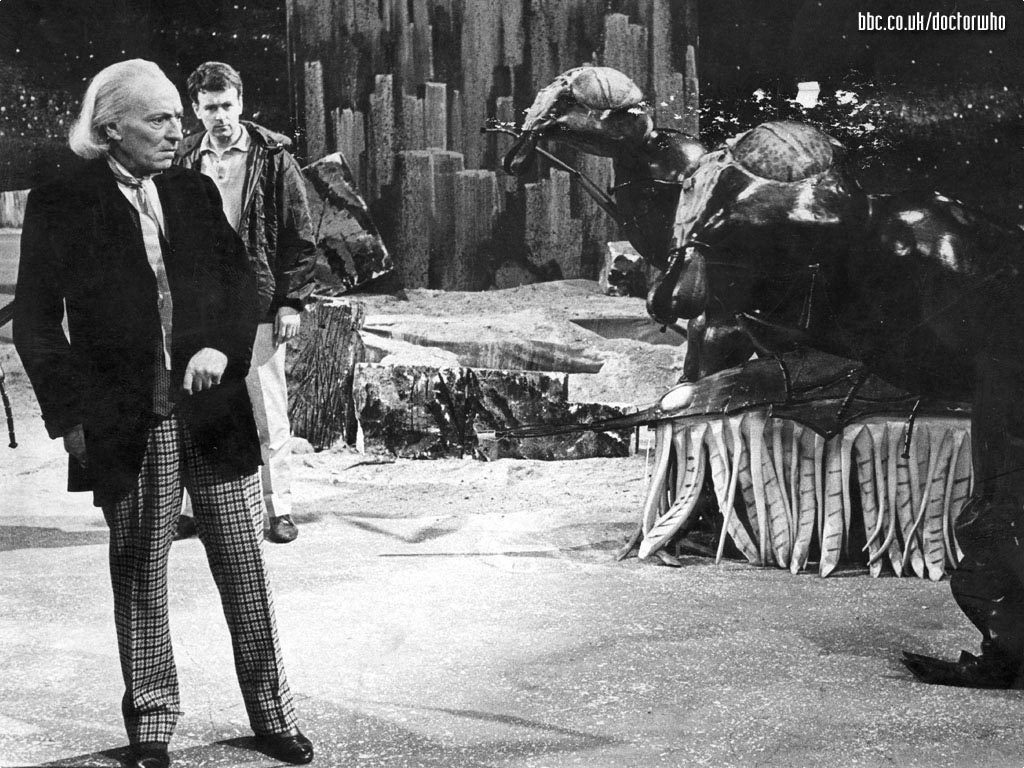
Some of these adventures work – indeed, most do. Some were wild experiments which are ambitious but sadly fall short for me due to the budgetary limitations. Whilst The Daleks’ Master Plan works wonderfully despite its epic scale, the same cannot be said for earlier attempts at this level of ambition such as The Keys of Marinus and The Chase, where multiple sets were demanded for short filming periods, resulting in shoddy-looking set pieces on shoddy-looking scenery. Likewise, ambitious projects like The Web Planet suffer, although that is principally down to the rather formulaic plot underpinning the extremely avant-garde production idea. Again, weak costuming and set design also mean that some of these projects suffer.
 
During his tenure, there was a wide variety of companions, too – again, since there was no tried and tested formula for them, they vary hugely in effectiveness. Whilst Ian, Barbara and Steven are particularly well-rounded, with a variety of idiosyncratic characteristics, others, such as Susan and Dodo sadly end up hitting wide of the mark. The characters themselves were too unreliable, varying wildly from alien school girl to shrieking hindrance in the case of Susan, and from idiotic and pointless white noise to engaging and mature young woman in the case of Dodo. From story to story, these characters were given no solid framework, and each writer took on the role as the script demanded, whether for better or worse. Always present is the boy’s own hero, perfectly embodied by Steven and Ian, and hinted at in Ben’s brief stint with this incarnation. With Hartnell’s health questionable at the best of times, this style of assistant was always needed – someone willing to roll their sleeves up and get physical. The young counterpart to Hartnell’s Doctor should have been perfectly embodied in Susan, a granddaughter of the same heritage with the same character quirks. Sadly, many of the ‘alien’ ideas were lost, and only serials like The Sensorites allow us to fully appreciate how wonderful her character could have been. Her replacement Vicki worked wonderfully, but in turn she was replaced by Dodo, whose very stupidity was so poorly sketched out that she was almost unbearable.

The rarest of companions, though, is Barbara, and it is a role that we will never see again – morally speaking, she is the Doctor’s equal, if not better. She sets him right, and helps to maintain a sense of balance. Jacqueline Hill’s performance in The Aztecs is why it is still one of the greatest Doctor-lite stories, and her ownership of her role in history, and her personal growth throughout, makes her one of my favourite companions ever.

We also have the ‘not-quite’ companions – characters like Katarina, Sara Kingdom and Bret Vyon who briefly travel with the Doctor – and again, it is testimony to Hartnell’s characterisation that at least two of these were shown to mature and grow thanks to his company. Katarina, sadly, was something of a wasted opportunity – but given that the part was originally intended for Vicki, that is unsurprising.

So all in all, with Hartnell we can see greatness – he is not one-dimensional, ever, and provides gravitas and mystery to the role, despite us finding more out about him through his character growth than we ever will with any other incarnation. He grows from his miserly first appearance, through his experiences with his companions, into a loveable, unknowable rogue, able as he is to flit between personas at the drop of a hat. Speaking of hats – on with Troughton...!

Thursday, 26 July 2012

The Reign of Terror


My experiences of The Reign of Terror have never been complete – a friend sent me all of the audio tracks to all of the stories from Hartnell and Troughton’s tenure and I listened to them all at length, filling in the blanks with the Lost in Time boxset.  With The Reign of Terror, however, I had only ever bothered to listen to the sound track, since the episodes had not been released on DVD.  Despite their availability online, I had simply made do with the luscious sounds.  I realise now that I was cheating myself – following on from the rather drab and monotonous The Sensorites, the TARDIS returns the crew to Earth slap-bang in the centre of the French Revolution – and it is stunning.

I’ve been able to watch this serial thanks to dailymotion, a fantastic website through which you can watch almost anything.  The user ‘matrixarchive’ is responsible for uploading the videos I watched, including the recons of parts 4 and 5, made using telesnaps and the original audio track, and they are well worth watching to get a feel for the piece.

Following straight on from the end of The Sensorites, where due to Ian’s jibes the Doctor gruffly informed him that Barbara and he could get off at the next stop, the TARDIS materialises in the middle of the French countryside, beautifully realised in a studio.  What is wonderful about this camaraderie between the crew is that they quickly manage to turn the Doctor back to their side – watching Ian rest his hands on Hartnell’s shoulders, with Barbara picking imaginary lint from his lapels and gently stroking him, you can see his cold exterior melt.  It is wonderfully tactile, and a pleasure to watch them gradually winning Hartnell’s Doctor over.  As they leave the TARDIS, there is a sense of bonhomie about the group, and the mood is a light and jovial one, as they exchange witty repartee.  (I promise I’ll try and stop using French jargon now!)

Everything about this first episode seems very light and fresh, until the two Frenchmen, D’Argenson and Rouvray turn up, wary of these outsiders in their safe house.  The crew quickly persuade the two rebels that they are not spies, and the house is surrounded.  What is interesting is that Dennis Spooner’s script recalls Lucarotti’s Marco Polo almost perfectly – when Ian, Barbara and Susan are questioned if they are alone, and they respond yes, Rouvray’s face drops, as he tells them that they discovered the Doctor and locked him upstairs unconscious.  As such, the travellers are not trustworthy – they have already lied.  As soldiers surround them, we could be excused for thinking that these two Frenchmen are our ‘supporting cast’ for the serial, there to tag on with our heroes through their adventure.  But where the jovial atmosphere has been there throughout, there is a bleakness to the end of this first part, as Rouvray is assassinated at point-blank range, and D’Argenson is executed off screen, as the laughter of the armed peasants fills the air.

The first episode ends with a cliff-hanger about 3 minutes in the making – the peasants set fire to the house and march Ian, Barbara and Susan away, leaving the unconscious Doctor trapped within the billowing flames.  Through intercutting smouldering hay, burning ladders, smoke billowing through doorways, the roof slowly catching, and the captured only able to watch in alarm, there is an epic sense to the cliff-hanger.

Of course, the Doctor is safe and well, thanks to the young child briefly met in episode 1.  Hartnell has a wonderful exchange with the boy, and the salute they offer each other, as well as Jean-Pierre’s offer to put the Doctor up in his house, is wonderfully touching.  That the boy longs to come and help, but must remain as “head of the house” is lovely. 

Hirsch’s direction is helped hugely by the wonderful set and costume design, as well as the use of location filming, the first in Doctor Who history.  Sadly, it is evident that it isn’t Hartnell doing the actual location filming – the spring in the Doctor’s step is too jovial for Hartnell himself – but it does help to create a sense of grandeur to the production.  His scene with the Road Work Overseer is brilliantly comical, and again, you can tell that Hartnell thrives on this comic balance with his character’s brusqueness.  What is interesting is that, even by the end of episode 2, we still have no idea who the central additional characters are.  We meet a vast array of characters, all brilliantly drawn and performed with panache, and yet most of them do not have names.  Even those that we have met who did have names have been left behind or killed.  Spooner’s script creates an epic scene – the French Revolution is all around the TARDIS crew, and everyone is involved, no matter how small.  The Overseer also has one of my favourite lines – “get to work... skinny!”, and Hartnell’s gobsmacked response is wonderful.

The crux of episode 2, however, is the incarceration of Ian, Barbara and Susan.  Split across two cells – William Russell was on holiday for episodes 2 and 3 and so only appears in pre-filmed inserts – the group are taken to the Conciergerie prison and locked away until they are to be taken to the guillotine.  The jailer is a fantastic character, played with flair by Jack Cunningham.  At the start of the episode, there is yet more threat of sexual violence where he tries to assure Barbara that, since he’s “so lonely”, she could keep him company.  Cunningham’s delivery of his performance is interesting – despite the fact that they are in pre-Revolution France, there is a touch of ‘Les Miserables’ in the performances of most of the crew – they speak in cut-glass English accents, or, in the case of the peasants, with a cockney drawl.  Cunningham, however, elects to maintain his Yorkshire accent, showing that he is a cut above the peasants, yet still miles below the stature of Lemaitre, Robespierre and the like. 

Ian’s reprieve following his discussion with Webster, where he is told to meet an English spy at Le Chien Gris in Webster’s dying breaths, shows an interesting side to Lemaitre’s character, and provides a hint at the spy Stirling’s true face.  Lemaitre comes across all-too-easily as someone who is up to something, and whilst it is evident that he is the Englishman, it is interesting to see his interaction with all of the other characters.  Ian’s escape in episode 3 due to the interruption of Lemaitre only confirms his identity. 

Episode 3 again has some wonderful comic moments, including Hartnell’s time within the shop acquiring his new costume – the look on John Barrard’s face when Hartnell tells him he has no money, and the speed with which he snatches the jacket back, is brilliant, as is his outburst about the Doctor’s clothing – “It’s little more than a fancy dress outfit!”  (I know cosplayers that would agree with that!)  Hartnell’s costume is magnificent, ludicrously over the top and perfect for that very reason, with a hat that Troughton would be envious of.

In this third part, the girls are saved by two French revolutionaries, Jules and Jean.  The scene in which they are sat in the back of the wagon, with peasants mocking them and laughing from their windows, speaks volumes of the society in which our time travellers have found themselves – one which is echoed by Lemaitre and Jules near the end of the serial.  They are escorted to Jean’s safe-house, and exchange tales of the route through the escape chain, reinforcing the idea that there is a mole somewhere within the rebels’ ranks.  Leon also joins them, and the scenes between Jacqueline Hill and Edward Brayshaw are wonderful, as we get the idea that a romance is blossoming between the two.  He is gentle and tender in his delivery, and Barbara is unsurprisingly swept off her feet.

Episode 4 is the first of the two missing parts of this serial, but it does exist in telesnaps and audio format.  Robespierre is introduced as a maniac, desperate for more and more executions – and Keith Anderson’s performance is terrific, a tour-de-force of paranoia and bloody-minded determination.  Sadly, this is also where the script starts to sag – despite Anderson’s performance, Robespierre, as an historical character, must maintain his dignity until the right time.  True historical characters are rarely seen in Doctor Who from here, and it is telling – whilst history must remain a fixed line, and they cannot rewrite “not one line”, it is impossible for the Doctor to face up to such a character and win.  His pleas and complaints fall on deaf ears, and the Doctor is relegated to being useless backing to the educational aspects of the show. 

The episode continues with the betrayal of Barbara and Susan at the hands of the physician and Ian’s betrayal by Leon Colbert, revealing himself as the mole within the escape route.  Spooner is warning that in such a time as the Revolution, allies can rarely be trusted – with a tyrant like Robespierre in charge, many will do anything to keep themselves safe.  Fortunately, Barbara is able to leave the prison due to the Doctor’s guile in his costume, but Susan is too ill to move just yet – although since it was the prison conditions which caused her to be so weak in the first place, one would imagine she would get worse, rather than being healthy as anything come her release in episode 6.  Ian’s escape comes at the hands of Jean, who executes the traitor, and he and Ian return to the house, where they break the news to Barbara that Leon had to be killed.

The discussion between Barbara and Ian about Leon’s murder is an interesting one – each side has a valid point, and it is one that has helped Doctor Who establish itself and continue running for nearly 50 years.  Whilst Barbara argues that he was a good man, with a good cause, doing what he thought was right – “A patriot” – Ian points out that whether they agree with his cause or not, they are involved in the history now, and that they have sided with the rebels rather than the revolutionaries.  He points out that it could just have easily been he who shot Leon, and they cannot be dispassionate onlookers any longer – if they are to escape, they must be proactive. 

The “Bargain of Necessity” of the title happens right at the end of the episode, with Lemaitre forcing the Doctor to take him to the hideout of the rebels – only then will Susan be released.  Lemaitre is, at this point, still undercover, and so the cliff-hanger depends upon the audience not realising who he is for it to be dramatically effective.  Episode 6 begins, again, with a great deal of exposition as the group realise that they are all working to the same ends, Lemaitre – or Stirling – included, and working out the best way to deal with the secret meetings and overthrowing of Robespierre.  Some confusion sadly arises due to a sloppy bit of scripting here, where Lemaitre and Jean discuss “Barras” and “sinking ships”, which somehow triggers Ian’s memories of what Webster said to him – the issue being, of course, that Webster never mentioned Barras, or the Sinking Ship, an inn just outside of Paris. 

The scenes in the inn are rather monotonous, for much the same reason as those involving Robespierre in episode 4 – it turns out that Barras is meeting with Napoleon Bonaparte,  an up-and-coming general who the Rebellion wish to lead the country with two others.  Again, as this is loosely based on hard facts, it is impossible for the TARDIS crew to do anything but idly sit by and watch as the education comes pouring out.   The scenes involving the overthrowing of Robespierre are rather gruesome, as he dashes into his office, locking it behind him and arming himself before the masses of armed peasants break the door down and, to stop him from talking so much, shoot him in the jaw. 

Of course, though, our group of travellers are reunited, and all head off to the TARDIS, where there is a rather wonderful speech over a screenshot of stars, discovering that their destiny lies out there, somewhere.  It is touching conversation between the Doctor and Ian, and as the voices stop, but the end credits start, the screenshot remains with that starscape upon it, inviting us to travel with them in the new season.

Monday, 23 July 2012

The Sensorites


The Sensorites has long been regarded by many Who fans as a bit of a miss – Neil Perrymen on the Adventures with the Wife in Space blog jovially remarks “67% fail halfway through this story” when attempting to watch the series from the very beginning.  Whether this comment is true or not is irrelevant.  It cements the group-culture idea that it is not a ‘good’ serial.

Yet it has certain elements which make it tremendously good fun to watch.  Some of the performances are excellent – Peter Glaze, Stephen Dartnell and John Bailey are particularly good – and the central ideas of xenophobia, and the dangers of war, are strong.  It is the script and direction here which let the story down.  Much like with Nation’s script for The Keys of Marinus, the central idea, whilst a good one, is let down by plodding unnatural exposition.  Peter R Newman’s script works at times, and at others slows everything down too much.  Mervyn Pinfield’s direction at times is stylistic and filled with flair – such as at the beginning of episode 1, as the camera tracks from within the TARDIS onto the deck of the spaceship – but at other times feels clunky and uninspired.  When Cox takes over for episodes 5 and 6, the whole affair feels slightly tighter, and episode 6 is one of the strongest, but part 5 still feels hindered by poor scripting and so still lags.

As the serial starts, the TARDIS crew are nonchalantly regaling their high adventures through time and space, with Barbara dismissing the Aztec affair with a wave of the hand, saying that she’s “over” that.  The whole group feels lovely and tightly knit, tactile and jovial as they discuss their past tales.  There is a lovely sense of unity amongst the travellers here, one which we’ve never really felt before.  They have become a family unit, one which audiences could no doubt have identified with strongly.  Once they step through the TARDIS doors, with a tracking shot reminiscent of Scorsese’s Goodfellas, there is a heightening of tension.  As they discover the two ‘dead’ bodies of Maitland and Carol, there is a feeling of adventure, heightened by Norman Kay’s incidental music.  The music feels rather patronising, with heavy clangs on words like “death!”, but all in all this entire first episode gradually ramps up the pressure nicely.  As Maitland and Carol are revived from their catatonic state, and deliver background story information to the crew – and therefore us, the viewers – we are treated to possibly the worst existing case of poor peripheral sight in all of Doctor Who’s history – stood a mere few metres from the TARDIS, whilst commenting about a burning smell, they fail to see the hand of the unseen Sensorite plunge into the screen, attempt to remove the lock by hand (just like the Voord a few weeks earlier) and then return with some sort of cutting device, removing the entire mechanism.

This is, of course, a staple of the early Doctor Who stories – the crew are forced away from the safety of their ship, and thrown into the danger.  In past stories they have had failed mercury links, stolen keys, force fields and tomb walls separating them from the safety of the TARDIS.   Here, the threat becomes somewhat more perverse – the TARDIS is shown to be penetrable, destructible in some way.  Rather than being the indestructive force we later see, the ship has been attacked, and damaged – it has been vandalised. 

So, the crew are forced to help Maitland’s ship – as it is drawn careering towards the Sense-sphere, and the Doctor has never been so proactive.   He saves the day, managing to draw the ship out of the influence of the unknown Sensorites, but the threat continues, as it is hinted that something is walking the corridors of the ship – behind the door which Susan and Barbara have unknowingly crossed the threshold of.  An amusing side-note is the way in which Susan exclaims “That’s funny!” about the door mechanism, opening based on motion – in exactly the same way the doors worked within the Dalek city on Skaro – the Daleks must have had the same carpenters as this expedition.  The reveal of John, wondering about maniacally mumbling about voices in his head are superb, and Dartnell’s performance is incredibly convincing.  His looks to camera don’t seem out of place, as though beseeching the unknown forces to silence the endless droning, making the audience feel uncomfortably aware that it could be coming from anywhere.

Whilst the music is good, the moments during which this first episode is most effective are the eerie silences – particularly as the crew stand around, in expectation, waiting for something to happen – anything at all.  And then, from the corner of the window, creeping up; it’s a Sensorite!  And it’s waving!  At least, it is in the cliff-hanger of episode 1.  The reprise for episode 2 has been reshot, and instead of the creeping, ominous feeling we get as it works its way up the window, it is just a man in a costume, stood around outside a window.  It is these little touches which let the production down.  Interestingly, part of the brief provided for this serial from Sydney Newman was that he wanted the show to portray normal jobs in a favourable light.  He knew that a high number of children wanted to grow up to be doctors and scientists, yet the uptake into engineering was limited.  Here, we see the practical application of science wonderfully.

Carole Ann Ford’s performance as Susan is incredibly strong throughout this serial – indeed, whilst The Aztecs was Barbara’s adventure, this is Susan’s, and she steps up completely.  The suggestion of her own psychic ability, and her mature performance as she stands up to her grandfather are excellent. 

Once the TARDIS crew leave the ship and head down to the Sense-Sphere (minus Barbara, who is sadly missed due to Jacqueline Hill’s holiday) everything seems to slow down.  The ratcheted tension of the previous two episodes stops almost completely, as we are given high levels of jerky unnatural exposition between the Sensorites.  I must say, whilst the Sensorites get some grief over the costume – principally for the plates on their feet making them walk all over each other – it is nice that they are so well designed.  What is a shame, however, is that each and every one of the masks is unique.  Typically, in Doctor Who, costumes and masks are identical – indeed, sometimes even using old costumes as new aliens, like with the Chrynoids.  Here, however, each one is expressive and unique – which would be brilliant, were the plot not hinged on the fact that they “all look the same”.  Much like the clone armies of the Sontarans in later serials, great weight is put into the fact that they are identical and almost impossible to tell apart – even the Sensorites themselves cannot differentiate, although this is justified by the script.  But as with Sontarans, the crew have not even attempted to hire actors of simply stature and frame.  Peter Glaze is about a foot shorter and 4 stone heavier than any of the other Sensorites, yet is easily mistaken for any of the others.  Likewise, the scripting does not aid us in our understanding, as no character is given individual names – rather, they are ranked – Elders go from First to Second, whilst all other Sensorites, many given titles such as Administrator or Scientist, are relegated in the credits to First to Fourth Sensorite. Added to this, the confusion which then arises as some play multiple parts, whilst others are promoted, and it becomes relatively confusing to follow.

Episode 3 ends with what is, in hindsight, quite a clever cliff-hanger; when Ian first coughs, the audience might be forgiven that it is unscripted, but not worthy of a retake – since The Sensorites contains an uncountable number of fluffs and messed-up lines, it would be forgivable.  But then he coughs the second time, as the Doctor mutters “a clue!” and all of a sudden, he’s down on the floor convulsing as the end credits roll.  That the water is poisoned is relatively clear from their heavily led discussion about it, which is why it is a shame that much of episode 4 is spent testing water – which we know will be contaminated – whilst the subplot involving Glaze’s Administrator continues.  There are some nice directorial flourishes here, such as the cross-fading between vial-testing and Ian, stricken in bed with poisoning.  In the subplot, there is a lovely scene which further highlights the plot of xenophobia, as the Administrator raves that humans are untrustworthy simply because they have “no badge of office” by which to differentiate them.  To him, they all “look the same”, and so when Carol makes this identical ‘astute’ observation to him, a further plot device is revealed – subterfuge and disguise.

What is refreshing about episode 4, plot-wise, is that it shows yet another side to the Doctor.  Until now, they have always ‘saved the day’ (or not, in the case of The Aztecs) and then left.  Here though, even though the Doctor has completed his end of the bargain and found a cure, he isn’t ready to just walk away.  Rather than simply discovering the cause of the poisoning and creating an antidote, he is determined to head down to the aqueduct to discover the cause, above and beyond what was expected of him.  He is no longer only acting for the selfish desires as he did in earlier serials – now he is proactively involving himself in events.  Quite where this sits with his thoughts on involvement and interference is unsure.  As I mentioned in The Aztecs, it seems that involvement in alien affairs is all well and good, but one simply cannot meddle with Earth’s history.

Episode 5 sees a new director – Frank Cox – stepping in to complete the serial, and there is a quick change in style.  Cox uses deep focus, framing the action nicely between scenery and other characters to great effect.  Sadly, episode 5 is also the dullest from a narrative perspective, and there is only so much a director can do with such dire exposition.  The scenes involving the Administrator blackmailing the Second Elder are nicely done, although the threat to his “family group” is a tad repetitive.  Likewise, the scene with the accusation of the Doctor as a murderer is so quickly unravelled it is ridiculous – the Sensorite making the accusations digs himself a deeper hole by the second, as he is uncovered within about 45 seconds of his accusation.  The “Kidnap” of the episode title doesn’t happen until the final 5 seconds of the instalment.  
Episode 6, meanwhile, is strong – this serial seems bookended by two tense and dramatic episodes, with very little happening in the filler between.  Bailey’s appearance as the Commander is wonderfully played – a frightfully British chief, determined that his men make the best of a bad lot, appearing dishevelled and filthy but insisting that “they’re a good bunch”.  With the emergence of the Commander and his men as the poisoners, Newman’s xenophobic discussion reaches a new point – highlighting that racism and intolerance in war only harms those trapped in the middle.  Both the Administrator and the Commander are wrong to be acting as they are doing; whilst each believes they are doing the right thing, it is those caught between that really suffer.  Once again, each of Bailey’s men are reduced to numbers, rather than individual character names.

The serial comes to a close with Carole Ann Ford at her very best, reminiscing of her home world – still unnamed for now – discussing the burnt orange skies and silver leaves on the trees.  Never has she appeared so alien as this, a young girl with no fixed abode, travelling the skies with her grandfather, and it is an evocative delivery which has been referred to since in Doctor Who mythology. 

So, if it is true that 67% of people fail during this series, I can feel pleased with myself that I am in that top 33%.  Next up, though, is Dennis Spooner’s historical The Reign of Terror, which has 33% of the story missing – and has not yet been released with the animated missing episodes.  Could this challenge be my downfall...?

Saturday, 21 July 2012

The Aztecs


After the average The Keys of Marinus, another Terry Nation sci-fi, Doctor Who returns to form with another glorious historical, once again penned by the magnificent John Lucarotti.  The Aztecs is probably my favourite Hartnell story in existence.  Perfectly scripted again, and with wonderful performances from everyone involved, it is troubling, educational, insightful and moral all at once, dealing with the conventions of the Aztec people, including worship of multiple gods in the hopes of appeasing each of them, usually with human sacrifice.

As was introduced last episode, Barbara, an history teacher, shows particular interest in this particular time period, and revels in the fact that they have arrived pre-discovery by Cortez, and therefore are able to appreciate this culturally advanced society, with regards to art and architecture at least.  Mistaken for a god at the beginning of the first episode, she embraces this culture fully, before realising that she is genuinely appalled at their ceremonies.  Despite warnings from the Doctor, in one of Hartnell’s best scenes ever, that she should never change history, “not one line!”, she interrupts the sacrifice, shaming the offering into committing suicide from the temple roof.  What is refreshing here is that once again the educational aspects of the show are not forced, but come from natural sounding dialogue.  Her desperation to make them see the error of their ways is fraudulent – it is forcing a moral code onto people who are not concerned by such things.  This culture has tradition, and this element is most important.  The question which arises is whether Barbara has any right to interfere.  Moreover, as the Doctor warns, interfering in the course of history can only end badly.


The key question, of course, is whether or not she is right to be doing it at all?  In all of the sci-fi stories, the TARDIS crew have stepped in and proactively brought about change; they taught the Thals how to fight back again, defeating the Daleks;  they destroyed the Conscience machine in Arbitan’s palace, wiping out the Voord along with it.  But in an historical story, that simply cannot be done.  History is a straight line, and it cannot be rewritten.  No, “not one line” (Take heed, Moffat!)  We know that when Cortez arrived, the Aztecs were savage, despite all of the art and culture of the time – they still killed people.  Of course, many killed in the name of their God at that time.  It just depended on whether it was the right God or not (see Pizarro’s conquest of Atahuallpa for evidence).  So whilst they have actively changed the history of planets they have visited, the history of the Earth must stay the same.  What we see here is that, despite her attempts to prevent the sacrifice, it leads to the ‘victim’s’ mortification – he was desperate to die, to prove himself worthy.  These people do not want, or need, saving from themselves.  They aren’t Thals being threatened with extermination by the Daleks, or citizens of Marinus being threatened by rapists, men in wetsuits and mind-control.  Instead, they are committed to their lifestyle and choices.  Where Lucarotti shines, and where Nation, with his one-dimension ‘moral’ stories fail miserably, is that these characters are so rounded, so understandable, that we are on their side.  The time travellers have no right to try to divert history – not because of the threat it would pose to history itself, but simply because these people do not want to change.

Barbara’s fascination with the period allows for a great deal of insight.  Autloc, the High Priest of Knowledge, represents all that is good about this Aztec civilisation.  He is pure, innocent, and genuine.  Tlotoxl, the High Priest of Sacrifice (“the local butcher”, as the Doctor and Ian refer to him) is dark, nasty, malicious.  However, Tlotoxl is actually the more insightful of the two – it is he who sees through the charade, and the cliff-hanger at the end of episode 1, where he threatens to “destroy her” shows that he understands far more than the priest of ‘knowledge’.  John Ringham’s performance is outstanding – he brings elements of Olivier portraying Richard III, shuffling and leering as he does, a knife permanently in his hand.  All of his dialogue with Barbara is delivered right up close, into her face, as he towers over her, looming like a malevolent giant. 

In episode 2, Hartnell is brilliant when delivering another powerhouse rant from the Doctor about interference – which is marvellous – but he suddenly changes tact completely and apologises for how harsh he has been.  We must remember that, until The Edge of Destruction, Hartnell’s default position was angry.  He was constantly ranting.  Following his apology in the third serial, he has become more grandfatherly, less crotchety.  This explosion of anger at the endangerment of his group would have seemed out of place any earlier in the series – Lucarotti never dared place a scene quite like this in Marco Polo, but it is a nice touch that shows that, serial by serial, they are growing into a family unit, working together with all of their might to get through.

Hartnell’s brilliance continues in those scenes which have him in the foreground – particularly in relation with Cameca, and discussing her with Ian.  His offhand comment “Yes, I made her some cocoa and got engaged” in episode 3 is wonderfully delivered in deadpan, and Ian’s double take as he processes the news is fantastic.  Again, everything about this serial feels so natural, and so fresh.

The direction of this serial is near flawless – John Crockett directed the fourth instalment of Marco Polo, and whilst that does not exist at all, we can safely assume that he was truly in his element with the historical.  The use of extras, particularly in the amusing and touching scenes between the Doctor and Cameca, are fantastic, particularly when Hartnell notices them all milling about behind them.  There is a touch of “Citizen Kane” in some of the shots – deep focus photography framing the less significant characters between things in the foreground, which speaks volumes of the hierarchical society of the Aztec culture.  The incidental music too is gorgeous – the tension mounts during fight sequences as the drums are gradually layered into the sounds of flutes and pipes.  Richard Rodney Bennett’s soundscape is evocative of a simpler time, and melds beautifully with Lucarotti’s script to create a magnificent sense of scope.

Keith Pyott as Autloc is wonderful, understated and heartbreaking.  The scene in episode 3 where he beseeches Barbara not to “deceive me, or prove false to me” is painful to watch, as we know that she is doing just that – she is purposefully lying to him, destroying his faith and forcing him to question all that he holds true.  In this story, more than any other, we see the crew of the TARDIS as meddlers, by no means making things better for those involved.  As the fourth episode comes to a close, and the Doctor et al run for the TARDIS, everything has gone wrong.  They have done no good, whatsoever – despite the Doctor’s claim that they improved “one man, and that is enough”.  This simply does not ring true; due to their interference, the only good and true person, Autloc, has relegated himself to exile, where he almost certainly will not survive long.  Tlotoxl has won, and he makes his sacrifice.  His new High Priest of Knowledge, Tonila, is an obsequious wretch, oozing slime as he does exactly as Tlotoxl tells him.  Nothing has improved for the better.  If anything, the crew have led the Aztecs into a darker way of life, with even more focus upon sacrifice and blood-letting.  Likewise, the destruction of Cameca is horrific to watch – she realises that the Doctor has no interest in her as she does him, yet she is still willing to risk her life for him.  The scene in which she attempts to bribe the guard with the seal is wonderful, but what akes it so special and so poignant, is that after Ian knocks her out, she still leaves the seal in his unconscious hands.  He has earned it, regardless of his willingness to help their cause.
 
Overall, this story demonstrates, once again, the majesty of Lucarotti’s writing, but more than that, it proves how strong the staple cast are too.  Jacqueline Hill has never been so good, and indeed won’t be again.  This is her personal favourite of all of her episodes, and we can see why – Lucarotti’s writing gives her the chance to sink her teeth into something morally and consciously reprehensible, and the pain in her face as she realises that she destroyed the faith of the only good man amongst them is terrific.

Friday, 20 July 2012

The Keys of Marinus


Sigh – Terry F*****g Nation again.  After the exceptional Marco Polo, the next story was always going to have to try really hard to impress.  The Keys of Marinus sadly fails to deliver.  It is entertaining, silly nonsense, and the concept is brilliant – indeed, it’s one that will be returned to, far more successfully, during Tom Baker’s tenure.  Sadly, though, this doesn’t work for precisely the reason that the Key to Time season does.  As a series of linked stories, an overall arc with a final goal, the concept works, but due to time constraints, and that great enemy of Doctor Who, budget restraints, this serial sadly flounders.  Don’t get me wrong – there are a number of excellent ideas in there; the episode set in Morphoton is based upon a brilliantly effective idea.  Indeed, it features the first hypnosis in Doctor Who, something which will be relied upon as a plot device time and time again.  But without time for some of the stories to develop, it all seemed a little brief and loosely handled. 

There are things to get excited about by this serial, or course – the first ever materialisation, some wonderful models, and the beautiful Altos are all amongst them.  Hartnell also has some corkers in this script, which are laudable – his point about shoes in the first episode never fails to make me chuckle.  It is just that, after such a natural, strong moral adventure as Marco Polo, Nation’s script all feels a little too flat and staid.  Conversations of educational import are thrown in, crowbarred into discussion where they simply do not sound natural.  Whilst Lucarotti uses education almost subliminally, Nation tacks random points on here and there.  Take, for example, the discussion of the ancient pyramids of Egypt and South America whilst they inspect Arbitan’s monumental home.  Despite the fact that Susan has disappeared, and they really should be looking for her, they are, instead, admiring the architecture.  It all feels so... well, glib, for want of a better word.  What is nice about this particular exchange is that it foreshadows the next serial, another Lucarotti gem The Aztecs, where Barbara’s fascination for the South American culture is the driving force behind the entire narrative.

Arbitan’s home is, in and of itself, a preposterous joke.  As Voord and crew alike are swallowed up by the walls, we are told that Arbitan has tried devoutly to keep the Conscience safe.  Perhaps if it weren’t so ridiculously easy to enter the building, it would have remained safer?  For one thing, he certainly wouldn’t have been murdered in the closing minutes of the story.  And after all of the lengthy and detailed discussion in the previous story, the suggestion that a machine could force every one on Marinus to have a conscience against their own free will is rather disturbing.  Whilst the Doctor and crew at first refuse to help, it is simply because they feel like they’re being put out by the whole thing, not on the grounds that it is morally reprehensible.  In fact, it isn’t until the closing monologue of the entire story, 5 and a half episodes later, that the Doctor admits that he thinks that such a machine should never have been allowed to exist, whereby making those preceding episodes irrelevant anyway. 

The Voord are quite an interesting idea – as is typical with the ‘monsters’ of the first few series’, costumes always led to rather unbelievable creations.  Here, though, they simply look like men in wetsuits.  Which is shit.  But, and this is the interesting thing, it is as though the production team realise that it is shit, and so instead make a point of saying that they wear wetsuits.  The dreadful costume is actually intentional, and serves almost as a private joke at the viewers’ expense.  The Voord are humanoid, at least, and don this protective clothing because of the acid sea surrounding the island.  Sadly, less convincing is the poor Voord who plummets to his/her/its death – clearly a one-dimensional cardboard cut-out.

Once the story gets off properly, we reach the city of Morphoton, a land of luxury and grandeur, which is actually disgusting and rundown, but everyone has been drugged into believing it.  And this is where the entire serial begins to fall apart.  Last week, we were on a glass beach, looking out over a sea of acid – “The Sea of Death”, in fact! – and inside an enormous temple dominated by a gigantic machine which controls the will of all of the inhabitants of Marinus.  This week, we’re in a dilapidated city ruled by brains in jars, where the citizens see splendour abound.  Next week we’re in “The Screaming Jungle”, the week after the cast are buried in “The Snows of Terror”, and the last two weeks are within the city of Millenius, before hopping back to Arbitan’s temple.  The issue, of course, is that for each of these various locations, unique sets need building.  Within the budget constraints of the time, they did their very best – Raymond Cusick’s design work is again very respectable considering what he had to work with.  In fact, an issue they had to overcome is that Cusick spent much of his budget on the Conscience machine, leaving him to scrounge and salvage much of the sets from other locations and TV shows.

The biggest victim of these financial restraints, though, is “The Velvet Web”, where through clever editing we are able to see the two perspectives in tandem – through Barbara’s eyes, the filth and grime is disgusting, yet from the perspective of the others, the place is paradise.  I love the scene where Susan proffers her new dress, and Barbara mutters “dirty!” like she were scolding a young boy for looking at pornography.  The difficulty faced by John Gorrie and the crew, however, is insurmountable; neither is the grandeur manageable, or the filth disgusting enough.  There are only marginal differences between the two sets.  Particularly considering it was filmed ‘as live’, it is respectable, as the two camera angles only allowed brief pauses to reset where editing was almost impossible.  But Nation’s script, despite being so basic, is far too brave to manage it all convincingly enough.

As they eventually escape from Morphoton into “The Screaming Jungle”, Susan heads off first, despite that not having worked too well for Barbara earlier on.  She arrives in the jungle, and proceeds to flagellate herself, tearing at her hair and moaning and screaming constantly.  Once the others arrive, she comes across as a needy only child, refusing to grow up – she is desperate to go with the Doctor, despite him evidently needing a break from her whining.  The management of Hartnell’s holiday – the first of many – is well controlled, as he makes the decision to head off for the fourth key, leaving the rest of the crew in charge for the next two episodes.  Again, the sets are the biggest downfall for this serial – not only did the script demand a jungle and a house which will be invaded by the plant life, but it also needed a complex series of boobytraps which were believable.  And again, Cusick has done his best, but they are simply rubbish – wobbly sets are excusable, but compared with how magical and wonderfully realised Marco Polo was, this just looks inexcusably bad. 

Edmund Warwick’s appearance as Darius is wonderful, though.  His suspicion of Barbara and Ian is great – even though seconds after trapping them both he calls for help as a vine attaches itself to his neck.  Warwick would later appear twice as the Doctor himself, doubling for Hartnell and appearing as a robot version of him in a later Nation story.  Here, moments before dying, he trusts the two companions, and whispers a scientific formula to them.  Again, my issue with this is twofold – first, Ian, as a chemistry teacher, should surely have figured this out quicker?  Secondly, considering the danger they are in, why did he not simply say “In the jar”?  It is convoluted, but allowing a certain degree of ‘education’ to slip in, I guess.
 
Once the second key is acquired, the crew are off to “The Snows of Terror”, buried in jabolite and freezing to the bones.  This episode works, to some extent, based purely on the appearance of Vasor, the trapper.  Francis de Woolff is brilliant, playing the villain like a bad guy from a DW Griffiths film in the 1920s – all that he is really missing is a lengthy enough moustache to twiddle as he raises his arms, tiptoeing around the room after Barbara.  And this is where it becomes mildly disturbing.  Doctor Who is principally a children’s’ television show.  Whilst adults do, of course watch it, it was conceived as an educational adventure series.  Here, though, the threat of sexual violence and danger is unnerving.  He wants to rape Barbara.  We know this.  We can tell.  It isn’t subtle, and as such even children must have picked up on it? 

Education worms its way in here, again, as we are told about frostbite and the correct way to prevents you from losing a finger.  Likewise, inside the scenes, a comment is shoehorned in about hot springs and the release of hot water from deep within the Earth.  The scenes in the caves are relatively tense, but again are let down by the set clearly simply being wrapped in cellophane.  The sequences on the bridge are acceptably scary – and yet this is the only time that Carole Ann Ford doesn’t scream.   Once the crew have returned to Vasor’s cabin, ice soldiers in tow, to retrieve their wristbands, they leave the rapist to be skewered by a sword and head off to Millenius, where Ian is promptly knocked out and framed for murder.

The episodes in Millenius are by far the strongest, as the budget for the sets was twice that of the other locations.  As a show, Doctor Who was still finding its feet, establishing exactly what sort of show it was.  As such, the courtroom drama model works well here, with Hartnell back from a break and on top form.  I can imagine few people better suited to represent you than Hartnell’s Doctor, who is all bluster and rage when arguing his case.  Again, for a children’s TV show, it is surprisingly glib about wife beating, as we hear a full-force slap across the face from the other side of a locked door.  When the wifebeater is murdered in the courtroom, shot by an unknown assailant, the cast give a respectable gravitas to the situation, as silence descends, and they all look around, shocked.

Of course, it is quickly unwound, Ian is saved from execution, and the bad guys are caught from their own stupidity, and our intrepid explorers, along with Sabetha and the irresistible Altos, return to Arbitan’s home, only to discover that Yartek is impersonating Arbitan – very badly.  What frustrates me here is that if the wetsuits are only protective clothing, why are they still wearing them inside the temple?  And if they aren’t just clothing, then the scene in the first episode with the empty wetsuit makes no sense whatsoever, unless the acid can boil the insides of a Voord, but not the flesh.  But then there was a tear in the suit, which is how the acid got in... Oh, never mind.  But the point remains that if Yartek were so desperate to appear like Arbitan, then surely a more appropriate vocal, as well as a cloak which didn’t make his face-mask look so blatant, would have done a better job.  However, Ian sees through the charade (if he hadn’t, we would not have been impressed) and gives him the wrong key, leading the temple, and the Conscience, to explode.

The serial ends with that good old Terry Nation staple, a soliloquy on right and wrong, as the Doctor surmises that maybe it is all for the best, as such a machine should never be allowed to exist.  The forcefield is removed from around the TARDIS – although goodness knows how since Arbitan dies moments after the crew left him – and the cast are free to continue their wandering through time and space.  And next time, we’re back with John Lucarotti in Southern America.  Seriously, Nation never stood a chance, bookended as he was by two of Lucarotti’s finest scripts.  Oh well, on with The Aztecs...