Showing posts with label Season 2. Show all posts

Tuesday, 9 October 2012

The Hartnell Years


William Hartnell is the Doctor. Whilst he may not have been the longest running, and he certainly isn’t the most popular in most polls held, he originated the role, bringing his own irascibility and grumpiness, but also his lovability and charm. His wit and sardonic humour radiate from him endlessly, and even in the direst of situations, his “hmm”s and tuts warm my heart.

Of course, he is renowned for his ‘Billy fluffs’ –invariably at least once an episode, Hartnell can stumble on a line. These are often cited by some as a reason for disliking his portrayal. That said, for a man of his age and in his condition, we can only sit and sigh in awe at the durability of him. Rehearsing almost every week of the year, on a dreadfully tight budget and schedule, Hartnell and his crew managed admirably. Considering his disease, he actually fared surprisingly well – there are bit-part players who fluff as often, despite only having the script for two-four weeks. In the 1960s, as we know, only one take was often allowed – due to time constraints, the show was filmed ‘as live’, and retakes were only allowed for the most catastrophic of reasons. As such, he endured being dropped on camera cranes, being hit in the face, and any number of terrible things – yet throughout everything, he managed to hide most of this, behind his genius characterisation of the Doctor as a doddery old man.

He is unfairly criticised as being too inactive – all of the ‘heavy lifting’ was left to his (admittedly more than) capable companions, Ian, Steven and Ben. Certainly, we don’t see him prat-falling around like McCoy and Baker, or energetically throwing himself around like Davison, or moving with a nimble, child-like glee like Troughton, or even karate-chopping henchmen like Pertwee. But that doesn’t make him any less the Doctor.

We must remember, though, that he is the First. He is the archetype of the character, the originator of many of the character’s attributes which we still see today. Without Hartnell (and the Daleks, admittedly) the series may never have run for three years, let alone 49. He took the essence of a character created by writers and made it his own. He actively changed scripts if he thought them inappropriate for the children watching.


What Hartnell does is encapsulate all that later Doctor’s embody in one go – he is loveable and miserable, grouchy and snappy, funny and clownish, abrupt and deceitful, all at once. His stories helped in that each script allowed him to bring a new trait to the fore – from the antihero liar of The Daleks to the lovable pragmatist and historical hero of The Aztecs, from moral peace-keeper in The Sensorites to the heroic old man who battles adversity in the face of illness in The Tenth Planet, he managed to create the template which is still being used to this very day. Many unfairly ignore Hartnell, and claim that it was Patrick Troughton who created the role as we now know it, and whilst Troughton is far and away my favourite Doctor, he simply took Hartnell’s lead. 

The joker of The Romans and The Myth Makers is the ball that Troughton, Tom Baker and early Sylvester McCoy picked up and ran with. The stoic pragmatist and heroic action man of The Dalek Invasion of Earth and The Tenth Planet is the template upon which Jon Pertwee, Peter Davison, David Tennant and Matt Smith modelled themselves on. The unapproachable and aggressive Doctor of An Unearthly Child and The Daleks seems to be the template for Colin Baker’s interpretation – admittedly one which should have gone full circle to encapsulate all of his traits rather than just those irascible ones. The darker and more dangerous characteristics of Hartnell’s Doctor are the template upon which later McCoy, Christopher Eccleston and later Smith will utilise.
Of course, the series itself had no consistency as such to speak of, so it is unsurprising that there seemed to be little or no consistency to the character or the stories he was involved in. And that is also the crux of what makes Hartnell so great – put him in any era, on any planet and against any foe, and he thrives regardless. In the face of any adversity, he steps forward, a new trait comes out, and he faces the challenge admirably. As each new brush came in, carving a new way with the accompanying production team, the style changed. Whilst later Doctor’s eras are renowned for Base Under Siege style drama, or the earth-bound UNIT tales, before settling back into a hotch-potch method like in Hartnell’s time, the earliest incarnation thrives on the unknowability of what is around every bend– from historicals to sci-fi, Earth-under-threat to stories of warring factions on desolate planets, there is rarely anything similar. From the quiet, self-contained stories like Marco Polo to the epic sprawling battles of The Daleks’ Master Plan, you could never settle down knowing what was coming.

Some of these adventures work – indeed, most do. Some were wild experiments which are ambitious but sadly fall short for me due to the budgetary limitations. Whilst The Daleks’ Master Plan works wonderfully despite its epic scale, the same cannot be said for earlier attempts at this level of ambition such as The Keys of Marinus and The Chase, where multiple sets were demanded for short filming periods, resulting in shoddy-looking set pieces on shoddy-looking scenery. Likewise, ambitious projects like The Web Planet suffer, although that is principally down to the rather formulaic plot underpinning the extremely avant-garde production idea. Again, weak costuming and set design also mean that some of these projects suffer.
 
During his tenure, there was a wide variety of companions, too – again, since there was no tried and tested formula for them, they vary hugely in effectiveness. Whilst Ian, Barbara and Steven are particularly well-rounded, with a variety of idiosyncratic characteristics, others, such as Susan and Dodo sadly end up hitting wide of the mark. The characters themselves were too unreliable, varying wildly from alien school girl to shrieking hindrance in the case of Susan, and from idiotic and pointless white noise to engaging and mature young woman in the case of Dodo. From story to story, these characters were given no solid framework, and each writer took on the role as the script demanded, whether for better or worse. Always present is the boy’s own hero, perfectly embodied by Steven and Ian, and hinted at in Ben’s brief stint with this incarnation. With Hartnell’s health questionable at the best of times, this style of assistant was always needed – someone willing to roll their sleeves up and get physical. The young counterpart to Hartnell’s Doctor should have been perfectly embodied in Susan, a granddaughter of the same heritage with the same character quirks. Sadly, many of the ‘alien’ ideas were lost, and only serials like The Sensorites allow us to fully appreciate how wonderful her character could have been. Her replacement Vicki worked wonderfully, but in turn she was replaced by Dodo, whose very stupidity was so poorly sketched out that she was almost unbearable.

The rarest of companions, though, is Barbara, and it is a role that we will never see again – morally speaking, she is the Doctor’s equal, if not better. She sets him right, and helps to maintain a sense of balance. Jacqueline Hill’s performance in The Aztecs is why it is still one of the greatest Doctor-lite stories, and her ownership of her role in history, and her personal growth throughout, makes her one of my favourite companions ever.

We also have the ‘not-quite’ companions – characters like Katarina, Sara Kingdom and Bret Vyon who briefly travel with the Doctor – and again, it is testimony to Hartnell’s characterisation that at least two of these were shown to mature and grow thanks to his company. Katarina, sadly, was something of a wasted opportunity – but given that the part was originally intended for Vicki, that is unsurprising.

So all in all, with Hartnell we can see greatness – he is not one-dimensional, ever, and provides gravitas and mystery to the role, despite us finding more out about him through his character growth than we ever will with any other incarnation. He grows from his miserly first appearance, through his experiences with his companions, into a loveable, unknowable rogue, able as he is to flit between personas at the drop of a hat. Speaking of hats – on with Troughton...!

Tuesday, 21 August 2012

The Time Meddler


The Time Meddler is one of my all-time favourite serials, not just from Hartnell’s tenure, but from the entire history of the show.  The first ever pseudo-historical, merging sci-fi and history together, it is also one of the funniest.  It could well be my most frequently-watched serial, alongside City of Death and Genesis of the Daleks.  It really is that good.

Uniting Douglas Camfield, one of the most sublime directors of the show, with Dennis Spooner, whose flair for comedy is outstanding, is a touch of genius in-and-of itself.  But adding to this the phenomenal Peter Butterworth guarantees class.  What is strange, then, is that in the first episode, The Watcher, Butterworth does very little but watch.  He eavesdrops from the cliff top, after watching the TARDIS materialise, muttering absent-mindedly to himself.  He is rather underused, but in such a way that it enthrals the viewer.  Just who is this man?  Bearing in mind that whenever the TARDIS has materialised, or dematerialised, in front of others before, they have commented on how they cannot believe their eyes, and yet here is the Monk, simply watching.  It is eerie.  He knows more than he should, which makes us want to know more.  It’s a wonderful method of engaging the audience.

The opening scene is beautifully underplayed by Hartnell and O’Brien – their discussion about missing Ian and Barbara really hits a nerve for the viewers;  I know I still miss them too.  Hartnell resumes his grandfatherly role, leading Vicki to the armchair and offering kindly words to her, before the pair is suddenly interrupted by the sounds of an intruder within the ship.  Peter Purves’ return is welcome to the series, yet he comes across as brash, uncouth and rude – his disbelief pours from him (“IDBI!”) as Vicki attempts to explain the secrets of the ship to him.  The dialogue is witty, yet we are not being asked to warm to Steven straight away.  Indeed, throughout this serial, we see him mellow, becoming a more appropriate character to be travelling in the TARDIS.  Purves does a wonderful job here of underplaying Steven’s appeal, gradually cooling off and becoming less abrasive.  Hartnell’s approach to this interloper is also brilliant, as he reels through his environ whilst ushering Steven out of the way – “A chair with a panda on it!  Sheer poetry, my dear boy!”

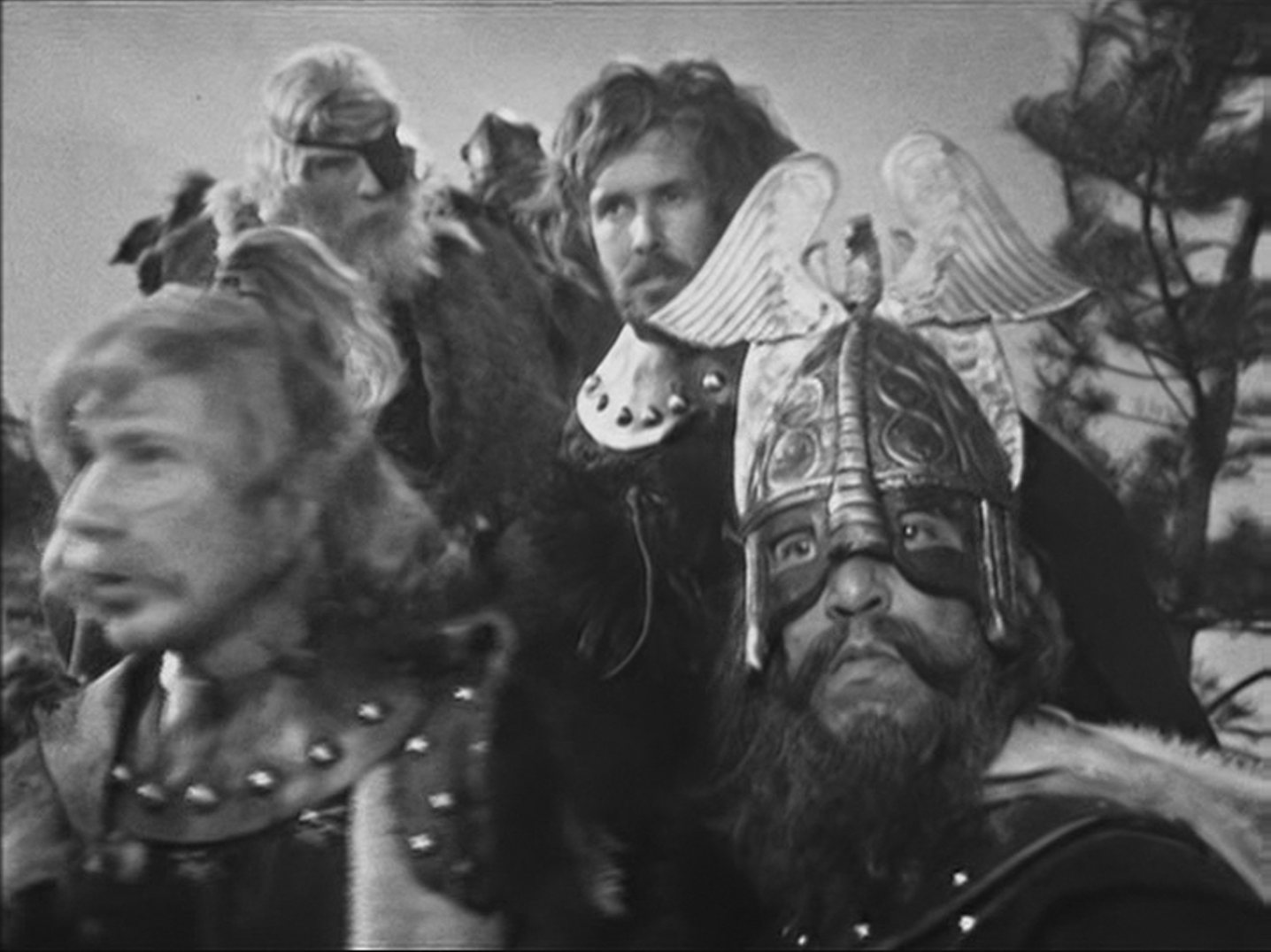
The scenes on the beach also include some fantastically witty lines – “a space helmet for a cow?!” – and Hartnell is on top form, no doubt because he was aware that he had a holiday coming up very soon (during part 2 of this story, in fact!)  The educational remit of the show is once again approached in a sensible manner, as Hartnell deducts their time and place based on the answers given to him by Alethea Charlton’s character, Edith.  Discussing past monarchs, as well as using clues such as the leaves on the trees, the Doctor deduces that they are in 1066, an infamous time in English history, and one still studied in school today.

What Spooner does with his script, and which Camfield monopolises in his direction, is the subtle use of anachronisms throughout.  In an earlier scene with the Monk, we see him purposefully glance down at his watch.  We’d be forgiven for thinking this was an unintentional accident, much like Billy’s brilliant fluffs in this first episode, but then it emerges that he really was looking at his watch.  The Doctor’s exploration of the monastery reveals that the chanting is actually emanating from a gramophone.  Rather than attempting to justify these inconsistencies, the show revels in them, throwing a curveball at the audience and then forcing them to wait again.  What is interesting is that whilst this serial is held in high regard by many Whovians nowadays, the audience appreciation index showed that, as the story progressed, most viewers disliked these anachronisms.  Many didn’t like historicals at all, and ignored the presence of a potential sci-fi twist.  In addition, those that did like historicals found the addition of sci-fi made the plot silly and frivolous.
 
The cliffhanger at the end of part 1 plays perfectly into Hartnell’s absence (fortunately no need for Edmund Warwick to double as the Doctor again!) and it is in Hartnell’s absence that two key things happen.  Firstly, Butterworth’s Meddling Monk is given more to do – he becomes a focal point, and milks comedy out of every movement and line of dialogue given; the scene in which he prepares breakfast, before having a drink thrown into his face from off-screen is great.  Secondly, it allows Vicki and Steven to take centre stage.  O’Brien is brilliant in this serial as, having travelled with the Doctor longer, she becomes the leader of the pair, much to Steven’s chagrin.  The scene in which the two are captured and taken to the Saxon village is smashing, as it allows Vicki to dominate, whilst giving Steven the chance to gradually defrost a little.  The low-key way in which, after shouting at the villagers, he gladly accepts their food and awkwardly mutters “thanks...  thank you.” is lovely – he realises what a pig-headed fool he was being.  Likewise, as they then leave the camp, his repetition of “god be with you” is touchingly delivered, showing this awkwardness again.

Alethea Charlton is wonderful in this serial – from her welcoming of the travellers, through to her assistance of the Monk, offering him food, she is fantastic;  but her best scenes are following the attack from the Viking invaders.  There is no question what has happened to her, yet it is never explicitly stated.  It is not often that a performance as convincing as this would make it into children’s TV, and the look of shock in her eyes and her inability to speak utterly sells that she has been subjected to rape.  It is awful, unnerving.

When Steven and Vicki make it to the monastery and trick the Monk into admitting that he knows of the Doctor is brilliantly played by all three – Steven tricks him into confessing he has seen the Doctor by gaining a description of the Doctor, but what adds to the sense of danger is Vicki’s suggestion that perhaps they are not being as clever as they think they are, and the Monk has pulled a double-bluff. 

Eventually, Steven and Vicki make it into the monastery to discover that the Doctor has escaped – “He’s gone!” Vicki exclaims – and leads us nicely into Hartnell’s return for episode 3, where he really comes into his own.  It is clear that he’s been waiting for a performer of Butterworth’s calibre to verbally spar with since the show began.  As with Nero in The Romans, he parries and defends with a razor sharp tongue, the “Battle of Wits” of the title.  What this episode does so effectively is that, once again, the conventions of the series are being altered, parameters are being moved.  Since The Aztecs, it was made clear that history could not be changed, “not one line!”  Yet here, Hartnell mumbles away to himself about the battle of Hastings and 1066, before finishing off with “that’s what the history books say happened”.  It’s troubling, because it suggests that time can be altered, if one is so inclined.  It means that things can always be undone, rewritten. 

Following the reveal that the Monk has his own TARDIS, we are faced with this dilemma – he suggests that by destroying the Viking ships, all of history will improve thanks to his intervention.  Hartnell instantly dismisses this, claiming it is against the rules of time travel, but the Monk doesn’t care one jot about the rules.  He is a man with a plan – indeed, he even has a chart plotting his plan step-by-step!  The conversation between Vicki and Steven is therefore rather troubling – if history were changed, then all of the future is instantly rewritten.  History books haven’t been written yet, so they’ll just have a different account of events in them when they are published.  What is nice is that they have no concerns for themselves – if history changes, and in the future rockets are invented hundreds of years earlier, then surely their own timelines will become null and void – Steven would never have been on his spaceship, and Vicki would never have crash-landed on Dido either.

The fourth episode is entitled “Checkmate”, rather fittingly – this battle of wits has come to its natural conclusion, and it is played out for the most part via the Monk’s TARDIS, a gleaming black floor directly juxtaposed by the safe, known confines of the Doctor’s white, sterile control room.  The jealousy that Hartnell’s Doctor clearly feels for this superior craft is palpable – he snaps “mind your own business!” when asked which model he has. 

One of the most brutal scenes in Doctor Who history is, allegedly, the killing of the two Vikings, Ulf and Sven.  Sadly, these scenes were cut and discarded, with only audio to tell by, but based on the special feature on the DVD “The Missing 12 Seconds” it all sounds rather gruesome.  It is fitting, though that this is missing – this last episode loses nothing in us not seeing the fate of the invaders.  Instead, it focuses on the lightweight matter of the Doctor and the Monk finishing their business.  The Doctor’s clear excitement at his plot, vandalising the Monk’s TARDIS, is wonderful, and he hams it up, giggling like a naughty schoolboy.  Upon the Monk’s return, Butterworth has a wonderful scene, alone in the vault, reading his note, scoffing at the possibility that the Doctor could possibly defeat him.  Of course, by removing the dimensional stabiliser and therefore shrinking the interior, the Monk is inexorably marooned in 1066.
 
But this is rather troubling.  It is made clear that the Monk likes to meddle in the history of Earth.  Following the end of Hartnell’s tenure, it is made clear that the Doctor, as a Time Lord, can regenerate into a new body, and it has since been set down that he can do this 12 times.  So sticking a fellow Time Lord (although that term isn’t used for quite a few years yet) in the past, with all of his knowledge and technical abilities, is surely a dangerous outcome?

Still, that’s all by-the-by.  The Doctor wins (of course) and continues in his travels amongst the stars, as the faces of Hartnell, O’Brien and Purves are superimposed over a star-screen brings us to the end of the second season.

Sunday, 19 August 2012

The Space Museum


The Space Museum is actually a very interesting concept, and one which is pivotal to Doctor Who in general.  Whilst the idea of interfering in the natural progression of time is one which has briefly been referenced in a number of other serials – notably the historicals, and particularly The Aztecs – it has always been the history of others, their past or future, which have been messed with; in sci-fi serials it is the status quo for the team to meddle and interfere, but in this, it is essential that they do, as it is their own fate which is at risk.

This serial is regularly criticised by much of fandom, and for some valid reason – it is a little slow, and a little messy, and a little... well, boring, in parts.  But that is sort of the point.  It is precisely for this reason that the serial works at all – that, and a corking first episode, of course.

From the creepy cliffhanger at the end of The Crusade, this serial kicks off with a number of bizarre incidents similar to those of The Edge of Destruction – strange noises and camera angles create a tense environment where water glasses can jump back into your hands complete after smashing on the floor, and the crew end up redressed by invisible forces.  Throughout, the Doctor is rather non-committal about it all, and the use of stock music fits well with the jarring incidents.  The direction on episode 1 is particularly good, using abstract angles and sweeping movements to disorientate. 

The central premise of this first instalment is fascinating – having somehow jumped a timetrack, the crew are invisible to the environment in which they find themselves, leaving no footprints, and unable to interact with anything (sort of – but more on that later!)  The model work on the Space Museum itself is magnificent – and the painting of the set flats to create a disjointed, abstract look is equally brilliant, although the effect is diminished somewhat by the shadows of the actors proving that it is only a one-dimensional flat painted to look 3D. 

As the crew make their way through endless corridors, looking at strange exhibitions and avoiding the Moroks trooping the place, there is a strange sense of déjà vu – each room looks identical, simply with different artefacts and exhibits on show.  The scene in which they pass through the TARDIS is genuinely shocking and rather haunting – the staple idea of cutting the crew off from the ship to force them to participate in events is a cliché now, but here it is reused to great effect;  they cannot interact with anything, let alone something as secure and known as the ship.  Sadly, there is a lack of consistency to this too – when Barbara hides behind a mannequin, the whole thing wobbles tremendously, showing that they can interact with some things, just not the ones which are input via technical skill!

The cliffhanger is brilliant too – when the crew discover themselves, frozen in exhibit cases, embalmed and left there forever to be gawked at by aliens, it is terrifically unnerving, although quite why it takes them so long to spot them is beyond me.  As they gradually catch up with themselves, and the exhibits fade, and footprints appear, the look on Hartnell’s face is wonderful – “we’ve arrived!”

Episode 2 is where the story begins to lose its way, though – once we have been introduced to the Moroks, and later the Xerons, it is difficult to remain engaged.  The Moroks are a bunch of petty administrators and curators, running the museum as a way of proving their ability as leaders, but bored of the monotony of it all.  The Xerons are even worse, though – they are too ineffective to do anything, referred to as “rebels” despite their inaction, and not even deemed worth oppressing properly by the Moroks.  Both races are seen as ineffective, pointless.  One side gloats over past victories, while the other sit around, not doing anything.  It is boring – yet that is precisely the point.  The serial works as a satire, to some extent, of totalitarian regime, and what happens once that regime has forced itself upon others.  The staleness, and the monotony, are integral to the plot.  There are some rather basic costume decisions, which are frankly slapdash, which do not help to engage the audience – it is a simple case of white versus black (albeit inverted) which is even commented on by the Xerons.  The dialogue in the opening scene with Lobos, the governor of Xeros, feels rather stilted and uninspired – he moans about boredom, forcing information into his exposition for the audience’s sake, is dreadfully dull.   

There is an interesting moment in episode 2 which baffles me.  Ian stands by, goading Barbara and Vicki as they lift a heavy glass case up from around a gun.  Quite why the women are doing the heavy lifting is not discussed.  It seems like an odd directorial decision to have made – just one of the many, of course.

The scene in which the Xerons capture the Doctor – before promptly losing him again – is another oddity, and one which doesn’t seem to sit right with me either.  The way in which the Doctor hides inside the Dalek casing seems tasteless, somehow.  Whilst Ian did the same thing in The Daleks back when the series was first finding its feet, for the Doctor to do the same thing, after the Daleks had been established as recurring foes seems strange.

What this episode does well, thanks to Jones’ writing, is discusses one of the key themes of the series – the concept of time travel and the repercussions of it.  Whilst they are endeavouring to do all that they can to prevent the future happening, it questions whether they could change it anyway.  The conversation in episode 4 is striking for this very reason.   There is a sense of predestination throughout, although an eagle eyed viewer – such as myself, and no doubt many of you reading this – would notice very quickly that the future has been changed from the very outset anyway.  Whilst the 4 bodies in the museum were on screen, it was quite obvious that Ian had all of the buttons on his jacket.  In episode 2, when he loses a button, it is surely a sign that they are no longer predestined for the same thing.  Likewise, and even more glaringly, the idea to use Barbara’s cardigan to leave a trail also proves that the future has been changed – the display case-Barbara had her cardigan on, yet here Ian iis chewing his way through it to create a loose thread.

Episode 3 suffers mildly from Hartnell’s absence – after being carted off for ‘treatment’ at the end of episode 2, he is away on holiday here, only appearing in the episode reprise at the beginning, framed with wonderfully atmospheric lighting.  Where the episode is great, though, is in the relationship between Ian and his unwilling Morok assistant, played by Peter Diamond.  Diamond had a similarly wonderful relationship with Ian in The Romans, where he appeared as the faithful Delos, assisting Ian in his efforts to recapture Barbara from Nero.  Here, though, the relationship is taken in a different way; this cowardly Morok guard seems to genuinely revel in assisting Ian, subtly, and one gets the impression that it is because he is, for once, being proactive and doing something, even if it is the opposite of his orders!

Also fantastic about this serial is Vicki’s role in everything that occurs – never before has Maureen O’Brien been able to showcase herself so much, always having to play second fiddle to Hartnell, or giggling awkwardly with Barbara.  Here, though, she is the principle cause for events to have changed so dramatically.  Once captured by the Xerons, she leads them to become genuine revolutionaries, as opposed to the ‘rebels’ with a cause but without action we saw earlier on.  The scene in which she tricks the computer is so ridiculous that I can’t help but love it – but it does, once more, reinforce the uselessness of the Xerons. 

Along with the wonderful lighting in Lobos’ office with Hartnell in the recap, there is also the lovely scene in which Barbara hides from her pursuers in a room, where she is framed by mannequins.  Also effective is the slow-fade to black, before cross-fading back up to show the passage of time – this wasn’t a recording break, which are usually signposted by these blackouts.  Rather, it is a clever directorial decision, which allows Jacqueline Hill the time to slump further down and mess her hair up a bit.  It is a lovely, tense scene – until it is ruined for us at home when we see the colour of the uniform of the searcher, whereby proving that Barbara is in no genuine danger.  For someone with such an eye for creepy shadows and abstract lighting decisions, Pinfield fails miserably at ratcheting up any kind of tension.  Indeed, when the Xeron finds Barbara, he says “you can see we’re nothing like them” – and again, it is such a simple statement;  they wear black, but the Moroks wear white.  It is similar in tone to the episode in The Sensorites where they all ‘look the same’. 

Once again, though, a bug-bear I have with this serial is that it is, once again, a retread of the storyline which we have seen since the second serial, The Daleks.  Oppressors being overthrown by the oppressed, an alien race being led to rebellion by the TARDIS crew.  It is becoming a little staid and clichéd now.

Episode 4 starts with a reshoot of the cliffhanger from episode 3 – and again, this loses a great deal of the tension.  Whereas before, Ian was staring almost directly into the camera, shocked at what is off-screen (the Doctor, treated), on the second take, even William Russell can’t seem to create any real drama in his tone of voice.  Most of the acting in this fourth episode is rather uninspired, a little ‘acting-by-numbers’, as we wind up to the predictable conclusion that the crew will be fine, that they save the day and escape.  What this serial does different to others, which is rather refreshing, although not realistic considering their allies, is that the crew do end up captured, but it is the Xerons who save them.  Whilst the crew have been proactively trying to change history, and by doing so avoid becoming exhibits, they have actually played right into the cases – every step they took to change their fate has inexorably led to their capture.  It is Vicki, however, who has saved them – by pushing the Xerons to do something – anything – it has meant that the Moroks are overthrown and the crew can escape.    There is a sense of predestination throughout which is lovely – although, as I said earlier, the change in costume for Ian and Barbara proved that history had changed anyhow.

All in all, whilst this is slow-paced and averagely performed, there are some wonderful things to enjoy.  If we take the entire serial as a satirical look at the boredom which comes from totalitarian regimes, it works.  If you look at it as an exploration of the ramifications of time travel, it works.  If, however, you’re looking for it to be a fast-paced action adventure... well, you know...

Saturday, 11 August 2012

The Web Planet


Ahhh, The Web Planet.  If I’m honest, this is the moment I have been dreading in my little task of re-watching the entire show from the beginning.  This blog hasn’t been updated for a few days for two reasons – firstly, my own personal laptop died a few days ago, with the first part of this entry (eps 1-3) already written.  Due to this, there may be a number of typos throughout this entry (if so, I apologise) as the spellchecker is a little dodgy and the keyboard layout is confusing!  Secondly, this has always been my least favourite serial of all time.  Even now, having rewatched it, I’m not sure why.  It isn’t that the effects are terrible – God knows I look beyond that often enough.  It isn’t that the sets are bad – they’re actually incredibly impressive considering what was asked for of the script.  It isn’t that any of the performances are particularly bad – they’re all at the very least acceptable, if not brilliant.  It is simply that it bores me.  I don’t know why – I truly do try my very hardest to enjoy it.  And this time, being objective and having watched the progression of the series episode by episode, it was more enjoyable.  But I think it is still my least favourite serial ever – and to watch all 6 episodes, it took three days.  More than 2 episodes a day just seems like too much to endure.


The first episode is by far the strongest, and begins where The Romans left off, with the TARDIS and the crew being dragged down onto an unknown planet, utterly uncontrollable, with the crew flustered and thrown asunder.  As they rush around the controls, desperate to find out what’s wrong with the power, there is still a huge sense of camaraderie, and what is most wonderful about it is the way in which Vicki has so easily slipped into her role as the youngest member of the crew.  Sadly, Maureen O’Brien’s character is given something of a short shrift here – one gets the impression that the part was written for Susan’s character, particularly in the scene in which only Vicki can here the invasive sounds of the Zarbi crying out, holding her hands to her head to block to sounds out; it is reminiscent of Carole Ann Ford in The Keys of Marinus. 

Whilst Richard Martin’s direction is hugely flawed for the most part of this serial – mainly due to his rather formulaic presentation of a serial which was far too ambitious given the restraints of the time – there are some wonderful touches.  The use of Vaseline on the lenses specially created for this serial is genius, and creates a truly alien feel to the serial.  Through the intercutting between scenes on the planet and scenes in the TARDIS, we really get a sense of the scope of this – outside, nothing is right.  Everything is disjointed, with light flaring from anything and everything, and the soundscape, with use of echoes, is equally jarring.  The start contrast we get between the interior of the TARDIS, warm and safe and evenly lit, against the exterior shots on the planet surface, with light catching the cast and set at bizarre angles, refracting madly, is impressive.

One would be excused for thinking that Bill Strutton, the author, had never seen Doctor Who before, as some of the characterisation seems terribly off-kilter with what we usually get with the main crew.  There is a scene in which Ian damned near dives headfirst into a pool of acid, exactly like Susan did in episode 1 of The Keys of Marinus.  Indeed, much of Strutton’s writing seems to echo all of the worst elements of Terry Nation’s earlier scripts – episode 5 is almost scene for scene the same as Nation’s episode 6 of The Daleks, with Ian leading an oppressed people to rise up against the oppressors – we have simply substituted the Menoptra for the Thals, and in the place of the Daleks, we have the Zarbi.


As with Nation’s The Keys of Marinus script, much of the difficulties here arise from the sheer ambition of the script.  Where Marinus was let down by too many sets being needed for the 6 episode run, here it is the sheer number of absurdly extravagant costumes which hinders the performance.  Given that the set used was only about 64’x67’, and the multiple locations, the entire production hugely overran at every shoot because of the inhibiting costumes, limiting movement and so preventing quick scene changes. 

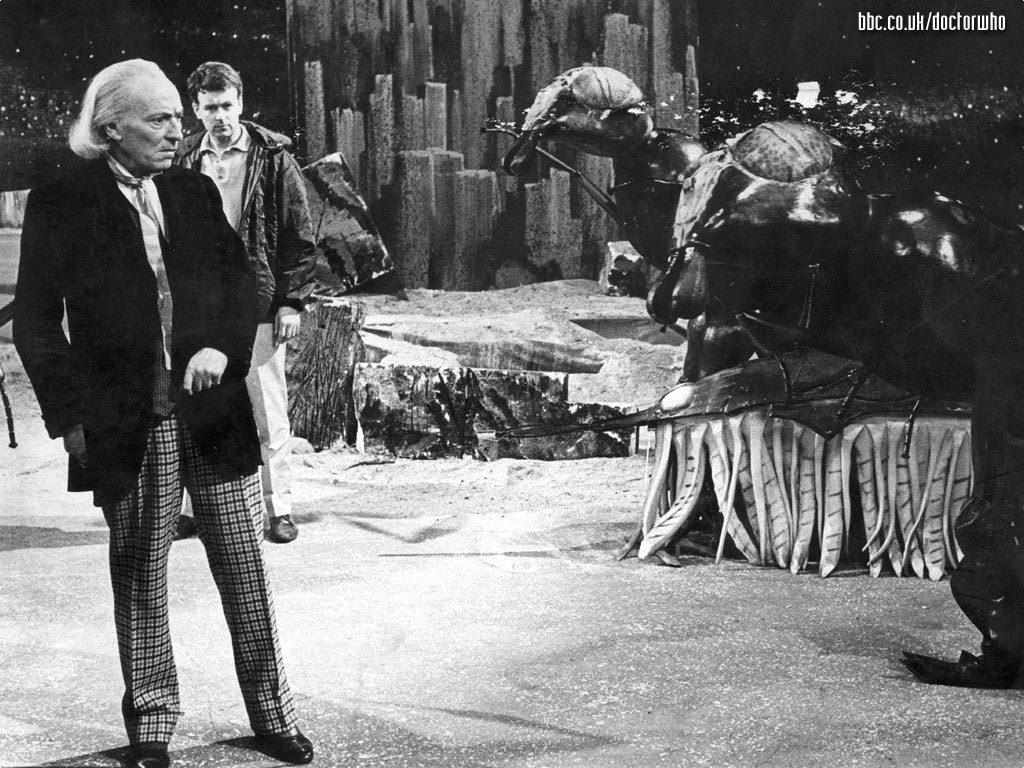
Episode 2 is where this serial really starts to unravel for me, and it is down to one simple thing which should never have been allowed to happen – the costume and movement of the Zarbi and the Menoptra.  What baffles me is that only a few weeks ago, the crew landed on modern-day Earth and were surrounded by huge earthworms and flies, and yet, in Planet of Giants, it was magnificent.  The sets were incredible, with superb model work.  Here, though, the creations have been left to Daphne Dare – who usually does a very good job – but the results are dreadful.  Due to the design, particularly of the Zarbi, actors movements were hugely limited.  Due to the large number of Zarbi required, the set is cramped and movement for the other cast become less natural.  Likewise, in the cave with the Menoptra, the huge wing design means that despite there only being 3 aliens present with Barbara, the set becomes minute and awkward, and movement becomes stilted.  Added to this the work of Roslyn de Winter, who also appears as Vrestin, as choreographer of the “insect movement”, with her absurd nuances and inflections, as well as awkward arm movements and head turns, and the entire thing becomes laughable.  A number of people say that the most embarrassing moment of being a Doctor Who fan is if someone were to walk in on you watching the scenes from The Happiness Patrol with Bertie Bassett.  For me, the most embarrassing thing about Doctor Who is this.  The Bertie scene was likened by someone as being caught masturbating – and when this episode is on I can’t help but glance over my shoulder, praying no-one walks in.  My partner was in the room for some of these episodes and at random intervals, he looked up from his phone, snorted with derision, and looked away again.  Sadly, I find myself doing the very same thing.

In addition to the dreadful movements and costume of the Zarbi in particular, the sound effects are possibly the most frustrating things ever heard in Doctor Who.  Whilst I understand the point – the Zarbi all look identical, and so by not having them able to communicate in English it makes them seem even more threatening – the use of the high pitched klaxon constantly, along with bizarre undulating chords throughout, made me nauseous. 

The cliffhanger to episode 2 is quite interesting, then – after all of the awful noises, and silly dancing, the communicator is lowered onto Hartnell’s head – and the voice that rings out is beautiful.  It is cold and emotionless, but soothing too;  as the voice of the Animus, Catherine Fleming plays the part perfectly, creating a sense of danger in the most human sounding part of the entire serial.  Even the TARDIS crew sound distorted on Vortis, but the Animus is crystal clear.

Again, due to the design and the set expectations, further embarrassments happen throughout the remaining 4 episodes – in episode 3, a Larva gun stands idly by in the background as we cut from Ian, captured, to the approaching Zarbi – purely because, due to the design and the size of the cameras, the same Larva couldn’t get to the right location.  Likewise, during the battle sequences of episode 4, Zarbi’s run head-first into cameras; sets jolt as camera lenses smack into the plywood frames through which they are shooting.  Usually, these sorts of blunders would be forgivable, and you could laugh them off.  Here, though, they add to the comical, farcical nature of the entire serial, making it look even shoddier than before.  Where long shots would have sufficed to hide the imperfections of the production, instead Martin’s direction keeps the camera up close, allowing us to see each and every failing.  That said, there are some nice touches – the scene in which the Zarbi attack the captured Menoptra, chewing off her wings, is disturbing, and is made all the more shocking because the camera cuts away to Barbara’s face, and the revulsion Jacqueline Hill portrays is wonderful.

Episode 4 works to some extent based on the interesting set – the Crater of Needles is wonderfully realised with 450kg of seaweed specially shipped in.  Shot through the Vaseline covered lenses, the light sparkles and dances across this abstract set – although what causes the majority of the flickering light has little place in a children’s TV series;  since the seaweed was collected fresh from the shores down south, a large number of condoms are mixed in with the vegetation!

To add to the misery of this serial, episode 4 also introduces a third species to Vortis – the Optera, centipede-like creatures who move as though their legs are wrapped in a sleeping bag.  With 3 sets of arms – only one of which move, with limited feasibility due to the costume – they look as ridiculous as the Zarbi.  These speak, but their aggressive, grunting delivery is reminiscent of Reece Shearsmith’s character Papa Lazarou from The League of Gentlemen.  There is, much like in The Dalek Invasion of Earth, an embarrassing lack of consistency to some of the aliens however.  As with the Robomen, the non-speaking parts shamble around in far less restrained manners.  Some don’t keep their legs together, simply meandering around on set.  De Winter’s choreography, which would be more at home in some abstract physical theatre performance, obviously didn’t sink in for all of the cast.

The fight sequence at the end of episode 4 and the opening of episode 5 is, like much of the action throughout, a miss-match of angles which sow little of any consequence.  Due to the restrictions, the movements are a mess, and the bumping and knocking is dreadful to watch.  What is amazing is that whilst Strutton never wrote for the series again, Martin managed to continue directing.  This is like a car crash, intriguing but horrific at the same time.  Episode 5 is by far the most painful of these to watch, as little of consequence happens – again, as with Nation’s The Daleks, it sees the group separated, each heading to the same location via pointlessly dangerous routes – and when we get to the climax of episode 6, it turns out that Ian wasn’t even needed anyway!  Episode 6 contains the dreadful screeching of the word “Zarbi” in any number of ways, with enunciation being placed on random non-existent syllables throughout. 

In fact, I’m still not really sure what does happen at the end.  Ian certainly doesn’t help – he just climbs out of the floor in time to witness it.  The Doctor and Vicki don’t help – they’re laid on the floor, wrapped in tentacles, and Hartnell is silently giggling to himself.  Barbara saves the day, using the Isoptope created to destroy the Animus, but the direction is so bad that it is impossible to be able to tell exactly how it all happens.

But, the Animus is defeated, and that’s all that matters – the serial is finally at an end!  Only it isn’t – there’s another ten minutes of the bizarre speech patterns and discussions of light between Optera and Menoptera alike.  It is strange – when the Optera were first introduced, their speech was interesting.  The use of similes and metaphors was intriguing.  Now, though, it just seems awkward and disjointed, almost entirely filler.

But then it really is over.  I sigh a gentle breath of relief.  Whilst I am a huge Doctor Who fan, and nothing will ever change that, this is, for me, the worst the series has to offer.  It was courageous, particularly considering that it is still early in the second series, but it did it.  Maybe the reason it looks so dreadful is that it has dated badly.  If that were it, I’d feel like a dreadful cynic for disliking it.  But everything about this is so sloppy that it just fails to engage me on any level.  I’m embarrassed by it. 

Why, oh why, does this story exist in its entirety when serials like The Web of Fear, Fury from the Deep and Marco Polo don’t?  It just isn’t fair...

Saturday, 4 August 2012

The Romans


The Romans is a courageous episode, for a number of reasons – principally, it is a comedy.  It works solely based on the idea that humour is milked out of every possible scene.  Added to this the rather grim subplots involving Ian and Barbara, and it is tremendously brave – balancing humour with such gritty realism is a hard task, but Spooner does it with aplomb.  As prompted by Verity Lambert, who wished for the series to broaden its dramatic range further still, she approached Spooner to write an overtly comical story.  What is so magnificent about the comedy in this serial is the very “Carry On...”ness of it all.  From the cast, most had since, or had before, appeared in the infamous series of British films, and much of the humour and performances would be right at home in Carry On Cleo or the like.  The combination of visual gags and word play, mixed with some slapstick physical comedy, all combine to make this a very successful comedy.

From the opening of the first episode, the tempo has changed enormously, and we can see the disappointment in Vicki’s face from the outset – following on from her joining the TARDIS crew in the previous serial, she has been presented with a month of relaxation in ancient Rome instead.  The scenes of the crew nonchalantly lying around, quaffing wine and grapes is brilliant.  What this rather effectively does, though, is to cement Vicki’s place with the crew – we haven’t had adventures where they have bonded, but rather they have become a united front – that family group again, by simply enjoying each others’ company.  Soon, though, the Doctor has decided to take Vicki on a little adventure, leaving Ian and Barbara to continue their relaxation, and outrageous flirting.  The action starts almost immediately, of course, as the Doctor and Vicki discover the body of murdered Maximus Pettulian, and the Doctor very quickly adopts his guise to ensure adventure in the city of Rome.  Maximus had been assassinated by a mute killer on the road to Rome, due to his involvement in a plot to assassinate Nero himself.  The Doctor does not realise that yet, and so it inevitably leads to many instances of humour arising from mistaken identities.

Whilst the Doctor and Vicki are given the humorous storyline, though, Ian and Barbara’s subplot about slavers and court intrigue is gritty and grim – kidnapped from the villa, they are forced to walk towards Rome before being separated and sold to different groups; Ian is sent to work on a galley ship whilst Barbara is bought for 10,000 sestertia and sent to Nero’s court to be a handmaiden for his wife Poppaea.  Despite the grimness of this storyline, there is still the occasional chance for humour – the fight sequence leading to their kidnap includes Barbara accidentally smashing a jug over Ian’s head, rendering him unconscious.

Education is once again in the forefront here, but subtly dropped in – the scenes with Barbara and Vicki discussing bartering, as well as the Doctor’s discussions of pipes and aqueducts, all provide ample educational stimuli without feeling awkwardly shoehorned into the dialogue, and the entire serial, with its presentation of ancient Rome, the burning of the city for rebuilding purposes, and the discussions about court conventions are all accurately discussed.

The first ends with the Doctor, now pretending to be Maximus, and escorted by Vicki who “watches all the lyres”, being taken to Rome with a Centurion.  The wordplay in this scene is exquisitely constructed, and it is almost impossible not to cackle with glee at the dialogue.  Once in Rome, the mute assassin is seen to be creeping up on the Doctor, alone in his room, vulnerable.  Barry Jackson is not given a great deal to do in this serial, merely grunting and weaselling his way around the cast – yet he obviously impressed enough to be later recast as the principal actor in Mission to the Unknown, as well as the Time Lord Drax in The Armageddon Factor.

Episode 2 opens with the Doctor dealing with Ascaris, promptly beating him in a physical fight, before he jumps out of a window to his death.  It is fantastic to see Hartnell enjoying himself so much – not only does he get to thrive on the sumptuous dialogue, he also gets to get his hands dirty bashing the assassin around.

Whilst the Doctor is having a whale of a time, showing off to Vicki, Ian is getting a far rougher deal – William Russell’s performance is admirable as an exhausted slave, and his friendship with Peter Diamond’s Delos is lovely.  Diamond isn’t the greatest actor in the world by any means – as a stunt coordinator by trade he is far better suited to the fight sequences in episodes 3 and 4 – but the balance is perfect between the modern day man and the ancient Roman.  When they are saved, washed away by water as the ship is torn in two, it is genuinely nerve-racking – not for Ian, but for sweet innocent Delos.  We know that Ian will be alright; companions are always safe, aren’t they? 

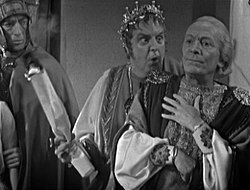
Barbara has once again pulled the short straw though, and once more the threat of sexual assault dangles over her – frequently a victim of the threat of rape, Barbara is pursued endlessly throughout this serial, desperately fighting off the advances of friends, Romans and countrymen alike.  The ultimate pursuer, of course, is Nero himself – and when he is first introduced in a scene with Hartnell, the pair sparkle.  Derek Francis is phenomenal, trudging though and burping with disdain at the musician, before elatedly being told that he is a man of genius;  the scene where he calls for a stool to rest his foot on, but Hartnell misinterprets is magnificent, as is the moment Nero calls forward a slave with a ledger, apparently ready to take a note, but instead simply uses him as a walking napkin.  His childish strops are spectacular.  Unlike in earlier serials where genuine Historical characters have been treated with a solemn and dignified respect – as Spooner himself had to do with Robespierre in The Reign of Terror, here Nero is presented as a buffoon, distasteful and sullen when he isn’t getting his own way, and delightfully camp and overt when he is. 

The rape subplot of episode 3 is horrific and wonderful at the same time – Nero’s pursuit of Barbara through the corridors of his palace are almost Benny Hill in presentation, casually covering up the serious physical threat to Barbara.  What is fantastic about this serial is the use of separate plot threads – where the crew are often separated, they do not tend to meet up again until the very end of the serial, as in The Dalek Invasion of Earth.  Here, though, they are always a few feet from each other, yet always unaware.  Hartnell tries to walk in on Nero with Barbara, and even stands outside the room in which he can hear her screaming, but does not interfere.  Likewise, by chance Vicki saves Barbara’s life, unaware that it is her that she is protecting.  In episode 4, Barbara likewise inadvertently saves the Doctor from being mauled by lions in the gladiatorial arena, unaware that he is pretending to be the musician Maximus.  They are always so close to each other, yet oblivious – which is what makes the final scenes of episode 4 so brilliant. 

The banquet, and the Doctor’s performance on the lyre, are magnificently scripted and shot, with just the right length of silence during the Doctor’s “Emperor’s New Tune” routine, interrupted by Tavius’ sneezing fit.  Nero’s retort to Poppaea that “He’s alright, but he’s not all that good” is hilarious, as is his soliloquy direct to camera as he plots the Doctor’s fate.  When he takes Barbara to the gladiatorial arena, inadvertently reuniting Ian and Barbara, the sword fight is magnificent – Diamond’s choreography is spectacular, and the struggle between his Delos and Russell’s Ian is great to watch.  Ian’s character is a fascinating one – having grown up during the wars, becoming a teacher in the 60s, he is an educated man always willing to fight – from his battle with Ixta in The Aztecs to this struggle with Delos, he is a smart and cunning fighter.

The fourth episode is predominantly about the Doctor and his dangerous relationship with Nero though – with Hartnell still mining some comedy gold out of the dialogue and performance.  Derek Francis’ elaborate over-acting, threatening to throw the Doctor and Vicki onto an island surround by alligators, is fantastic, and the dawning realisation in his eyes as he rants, before proclaiming them geniuses for the idea of burning Rome to the ground.  And this is one of the most interesting moments in Doctor Who’s history.  Vicki’s comment that the Doctor has interfered with history is a valid one, and supports his arguments with Barbara and the Aztecs, for one thing.  However, it begs the question of whether the Doctor has actually interfered – in July 64AD, it is a known fact that Rome was burnt to the ground.  So, maybe – just maybe – the Doctor had always been predestined to prompt Nero to burn the city.  Had he not accidentally set fire to the plans, could history have been altered forever?  The moment in which he maniacally cackles to himself, cross-faded to Nero playing his lyre surrounded by the burning city, is brilliant.

Of course, Ian and Barbara are saved thanks to the courage of Delos and the assistance of Tavius, and return to the villa to eat, drink and rest after their exhausting few days.  When the Doctor and Vicki arrive home, their presumption that Ian and Barbara have simply been lying around, flirting outrageously for the entire duration of their adventure, is marvellous.

My only criticism of this serial, if there was one to be had, is the relatively small role that Vicki plays in the whole thing – whilst she is evidently an established cohort of the TARDIS crew now, she seems mildly underused in these episodes; strange, considering that it was written by the incoming script editor to ensure some consistency with her character.  What Maureen O’Brien’s character is able to do, though, is to look at the story from a different perspective – changing history isn’t such a bad thing after all, and involvement can be fun as well as risky.  It’s a mantra which the series will follow for years afterwards.