Showing posts with label Night Shift. Show all posts

Saturday, 28 July 2012

Night Shift Part Two


Night Shift continues in much the same vein as before, providing chilling accounts of the ordinary, with some paranormal or alien plots thrown in for good measure.
Sometimes They Come Back is a horrific tale of a man haunted by ghosts – both literal and figurative – from a night when he was younger and a group of boys killed his older brother.  Jim Norman is an English teacher – for a change – troubled by the incident involving his brother when he was nice years old, walking home and being jumped by a group of ruffians with a switchblade knife.  After he starts a new job in a new town, he is terrified to come face-to-face with one of the perpetrators, who somehow has not aged a day since the incident.  As more and more pupils disappear from his class, to be replaced with all of those responsible for his brother’s death, he realises that he must face his demons once and for all.  What is startling about this short story is the fear it produces, not only of others, but of the power within each of us.  He summons the spirit of his brother, who deals swiftly with the attackers – but it ends on a haunting line that whilst you can summon the dead, and “perhaps cause them to do your work... But sometimes they come back.”  He is still haunted, even after all he has been through, by the thought that “maybe the nightmare wasn’t over after all”.

Strawberry Spring is a bit of a hit-and-miss story, an account of a serial killer in the vein of Jack the Ripper walking the foggy nights on a University campus.  Told from the perspective of one of the students on campus, the cliff-hanger is somewhat predictable, showing that perhaps it was an unreliable first-person narrative after all.

As in Battleground before it, The Ledge tells the story of a man, forced by the husband of his beloved, to compete in a “wager” for money, freedom and the woman.  The narrator, Norris, is a tennis coach who has fallen in love with Cressner, a man from the “Organisation” – much like the anti-hero from Battleground – and is challenged to walk around the edge of the building, forty-odd stories up.  With no choice but to do it or face life in prison, he accepts the wager.  It is a Hitchcockian thriller, one man facing his fears for all that he holds dear.  The kicker here is in the ending, where the truth comes out and Cressner is forced to do the same thing, with the open ending “Cressner said he’s never welshed on a bet – but I’ve been known to”.

One of the most obscure and disturbing stories in this collection is The Lawnmower Man, thankfully nothing like the dreadful film created and apparently inspired by the short story – a claim which King refutes vehemently, and took the publishers of the film to court over.  Principally about a man realising he is unable to continue mowing his own lawn after an horrific event involving a neighbour’s cat and hiring help, it centres on the so-called Lawnmower Man, a huge man with a tremulous stomach and bizarre methods.  The description of the Lawnmower Man is disgusting, but we are lulled into a false sense of security as Harold realises “now he had placed the man, and everything was alright”.  The scenes on the lawn, however, are anything but alright – the eponymous grasscutter is naked, devouring all that the lawnmower automatically produces as it mows the lawn, following it on hands and knees as his stomach swells, green juices running down his chin.  The description is nauseating, and the explanation is bizarre – the boss, “Pan”, likes things to be done this way...

Quitters, Inc. is a fantastic piece on the power of addiction and the lengths to which some go to manage their own will power.  Ostensibly through emotional blackmail and the threat of physical danger, a company ensures that people quit smoking – for if they don’t, their loved ones will be tortured and maimed, and they will be murdered if they lapse more than nine times.  Whilst it is an outrageous premise, deplorable considering the stance on human rights it neglects, it works fantastically well.  After their treatment, the ‘victims’ feel hugely improved, and are responsible for spreading word of the company by word of mouth.   The scenes within the office, as Mr Donatti proclaims the truth about Romanticism and Pragmatism, are exquisitely crafted.  This isn’t horror – it is a psychological warning which rings true throughout – worryingly so.

The next story sees King return to his typical genre – I Know What You Need is the tale of a girl wooed by a boy’s apparent knowledge and understanding about everything to do with her, and pleasing her exactly as she wants.  Following her first meeting, she is haunted by the thoughts of Edward Jackson Hamner Jr, and following the death of her fiancĂ© in a car accident, falls utterly in love with him.  Of course, there is more to it than meets the eye, and the discovery of voodoo dolls and mystical tomes in his wardrobe proves that he was manipulating her all along, having loved her since he first saw her in primary school years before, but who she has no memory of.  The sense of eeriness around Edward’s character is fantastic, as his past is dragged up by Beth’s roommate Alice.  Her exclamation that it is not love, rather “rape”, is disturbing.  When she invades his home, with doubts in her mind, there is a whisper of The Shining about it, as she recalls the Grimm tale of Bluebeard and his wives.  Likewise, it harks back to Strawberry Spring’s locations, set on the same campus.

Children of the Corn is probably King’s best known work from this selection of stories, principally due to the incredibly good film adaptation – a young couple stumbling across a town devoid of adults and wrapped up in religious mania – but here it is shorter, more succinct and as such even tenser.  Unlike in the film, the couple in question are not a loving couple, but a bitter, resentful pair, desperately trying to make their marriage work by spending some quality time together, knowing full-well that it will make no difference whatsoever.  From the discovery of the dead child on the road, through to their trip into Gatlin, their marriage deteriorates further and further – where the tragedy should have brought them together, it is the stubbornness of each party which causes the rift to widen and as such leads to their demise.  In particular, Burt’s stubbornness to accept that his wife, Vicky, was right all along leads to her being trapped in the car as the children swarm, armed with jack-knives, rocks and hammers – “Rural weapons”.  Dressed in Quaker clothing, they sacrifice the adults to “He Who Walks Behind the Rows”, a concept which will be further expanded upon in The Stand.

The next story, along with the final one, seems so unKing that they seem to have no place in this collection whatsoever, and yet they are two of his finest pieces.  Where others rely on shock and horror to create discomfort in the reader, here it is the breakdown of the family unit, and guilt over lack of connection, which preys on the reader’s sensibilities.  The Last Rung on the Ladder tells the tale of a brother and sister brought together by courage, as they perform daring stunts in the hayloft of their barn.  When the ladder collapses, leaving Kitty dangling seventy feet above the bare wooden floor, it is the speed of the brother’s quick-thinking which saves the girl from certain death.  This act brings the two closer together than ever before, but it is the gradual distance – which Larry feels responsible for – which has torn the two apart again, and the suicide note from Kitty at the end of the story is filled with remorse for a life wasted – “it would have been better for me if that last rung had broken.”  It is hauntingly desolate.

The Man Who Loved Flowers is a short and bittersweet tale of a man in love, buying a gift for his beloved before meeting her in a dark alleyway, and smashing her skull in with a hammer.  She isn’t his Nora, and never will be – but he is trapped in a never-ending charade where he goes to see her anyhow.  It is depressingly vivid, a tale of the broken-hearted, and the language used is particularly effective – it is described in simple, gentle prose, with heavy use of repetition for dramatic effect – the “spill of flowers fell out of his hand, the spill spilled... spilling red, white, yellow tea-roses” along with the blood of the innocent young girl.

One for the Road works as an effective end-note for ‘Salem’s Lot, reinforcing the work of Ben and Mark at the end of that novel.  Set during a blizzard some years after the novel, in a neighbouring town, it is a tale of courage as two locals go out to face the demons of the town in the hopes of saving a young family.  The descriptions of both mother and child, beautiful and perfect in their death, standing “on top of the snow, no tracks in any direction” are superb.

The last story in the novel shows the true versatility with which King can write – as with The Last Rung on the Ladder, The Woman in the Room features nothing atypical of the horror genre, and yet is still haunting in its desolate description of the love of a family, and the hardship faced by a son who wishes to put his mother out of her cancer-enforced misery.  The disconnected narrative flows through a series of events, leaving one to move onto another event with flickering ease, like the disconnected thoughts of someone in their final moments.  He hates that he must watch his mother in her endless suffering, paralysed and uncomprehending in her final days, weeks or years, and so decides to commit euthanasia.  Matricide, even,  The love which he has for this shell of a woman, this ghost in her bedroom, is what makes the story all the more poignant – and after the pills are administered, that he considers forcing her to vomit them back up, to save her, before realising “he could never hit his mother” is an emotional tour-de-force.

Thursday, 26 July 2012

Night Shift Part One


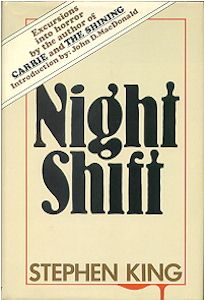
Night Shift is one of those Stephen King books that I have very, very fond memories of acquiring.  Whilst I’ve always loved his writing, and grabbed his material with both hands whenever possible, this particular collection, and his novel Duma Key, are two which I will always hold in fond memory.  They were each purchased whilst I travelled Europe with my partner – a passage around Europe which began with a clapped-out camper van and ended with us both in a tent for the 3 months we travelled due to engine troubles.  Whilst in Amsterdam, only the second stop of our journey, I had already devoured two-thirds of the books I had taken with us (just over a week in) and so I was delighted to discover in a service station not only a Stephen King book, but one which I had never even heard of – it was a new release, and so there was no hype about it.  This was Duma Key.  And it went down in solid chunks, read within a day and a half of buying it, with the ferocity with which I usually approach King’s new material.

My second purchase, and the only other of that holiday, was Night Shift, a collection of short stories which, somehow, I had never stumbled across before.  This was in the south of Spain, nearing the end of our journey – I had already been reduced to reading The Stand for the third time in those three months as I had nothing new to approach – my supply of Terry Pratchett, James Herbert and, of course, Stephen King, had dried up, so I was resorting to reading and rereading the same old things.  Oddly enough, in Europe, whilst they have an impressive number of literary releases, very few of them are in English.  I was screwed – marooned in foreign lands with nothing fresh to read.  So when we stumbled across this campsite, a veritable village in its own right, utterly self-sufficient with shops, bars and restaurants, I hit a goldmine – there, peeking between tattered copies of Mills and Boone semi-porno novels and tatty classics like Dracula and Frankenstein, it stood, begging for me to absorb it into my consciousness.  And I did.  My god, how I absorbed it.  Because I knew this book!  I had never read it before, but most of the stories had already been burnt into my cerebrum, through gossip with other fans and through film.  A huge number of these stories have been put onto film – short stories adapted by the master himself.  Three of them were instantly recognisable because of other works I knew – two were a prologue and epilogue of sorts to ‘Salem’s Lot, and one was linked to my most-thumbed King edition, The Stand.

But I get ahead of myself.

My intention is to look at each of these gems, in turn, starting with Jerusalem’s Lot, the first of the collection.  As we can tell from the title, the plot of this little gem is closely linked the third novel released, and officially the last King title if we discount the ‘Bachman’-penned Rage.  A prequel of sorts, it tells the story of Charles Boone, our narrator, and his discovery of dark rituals and mysterious goings-on in the town of the title.  Told in an epistolary format, addressed to “Bones”, we follow the discovery of vampires and a worm from the 18th century which has enveloped the town in a shroud of death and pestilence.  This story works as an effective prequel specifically to any that have read ‘Salem’s Lot, but works as a stand-alone tale of fear too.  The endnote of the story is particularly haunting, as we discover that Boone is not the last of his line, and as such the misdemeanours of his family are set to be repeated further down the line.  The narrative flows like a HP Lovecraft wonder, rich in intrigue and striking a perfect balance between language and mood. 

Graveyard Shift is one of those darkly sardonic little gems which you can’t help but love.  Whilst the characterisation is a little scant, and motives are left mostly uncovered, it doesn’t affect the piece at all, with a snappy pace.  In the end, though, the motive is irrelevant – it’s a dark tale of a man pushed by senior management to commit what turns out to be his undoing.  He is desperate to prove his worth, no matter the cost.  Unlike Rage before it, though, we do actually side with Hall – Warwick is a despicable man, a typical middle-management type with a bee in his bonnet, and an understandable loathing of rats and bats – “gah!”   Some nice touches from this story include Wiskonsky’s “sour prophecy ‘Somebody’ll get hurt’”.  Also, the Orange Crush Thermometer which reappears later.  As I have said in earlier blogs, for King, it is these touches which make him a cut above the other writers of the genre – we are, as an audience, asked to make connections.  When locations are mentioned in brief passing, we must remember where we’ve heard the name before.

Night Surf served as the inspiration for The Stand¸ and tells of an evening for a group of late-teens who have hightailed to the beach to get away from A6, a virus killing off the population in droves – also known as Captain Trips – which seems like “flu – he’s all swelled up”.  It works almost as a coming-of-age story, like those of The Body, but with a particularly morbid twist – the discovery of a man stricken with the illness is pulled from his car and the group set fire to him, offering a sacrifice.  As our narrator and his pal discuss it, Needles shrugs about the agony suffered by the man as he dies – “Doesn’t matter”.  The bitter realisation that they are not immune, despite their earlier thoughts that having had A2 meant they wouldn’t catch it because one of their own has the tell-tale signs is dreadful, imagining themselves as the last people on Earth, but that the world will continue to spin anyway, the tide will continue to lap the beach as the corpses all pile up.

I am the Doorway is a beautifully crafter little sci-fi shocker, as an invalid astronaut returned to Earth realises with growing horror that after five years, his body has been harbouring an alien intelligence that is growing through his skin and committing atrocities.  One of King’s trademarks is the way in which he copes with the evil inside a man – whether psychological or, in this case, physically reaching through the charade of our human mask.  We, as humans, are all capable of evil acts, but we, for the most part, manage to hold it together, and choke down that evil.  Here, though, it is Arthur’s very inability to contain it, to defend himself from it, which is most startling.  As a first person narrative, we are recounted the events as he remembers them, including the death of his friend and the murder of a young nameless boy, and his subsequent removal of the eyes growing through his hands by soaking them in kerosene and burning them off, leading to their replacement with hooks.  Now, though – and this is the truly horrifying part – seven years later, the eyes are growing again, this time in a perfect circle through his chest...  He hasn’t stopped whatever force it is, and there is no telling that he ever will, even in his suggested suicide as the story comes to a close.

The next story in the collection, The Mangler, is typically Kingsian in tone – a possessed machine, much like the Buick 8 and Christine from later stories, is hungry for blood.  The fear of the ordinary, and the trusted, is the central creepy premise to this.  An inanimate object, a clothing flat-press in a laundry, has caused a number of accidents, the first involving the blood of a virgin, which has sated its taste for blood and led to it wanting more.  My only issue with this is Jackson, the English teacher who is a friend to John Hunton, the central character.  As always the English teacher in King’s work is well-educated, but here, the knowledge all seems a little too forced.  Unlike Matt Burke in ‘Salem’s Lot, who we witness educating himself in the more specialised areas of fiction and folklore from a hospital bed, here Jackson can knock off any number of causes and signs of demonic possession all too readily.  Whilst it is clearly an issue irresolvable in short story, this is one which would perhaps have been better suited to a longer piece in one of King’s specialised collections like Four After Midnight or Different Seasons.  Given greater pagination, it is a plot which could have enthralled and mystified, but sadly here it all seems a little too rushed.  It is great – just not the best of the bunch.

Also a weak point of the collection, The Boogeyman is principally about a man dealing with his own skeletons in the closet, following the deaths of his three children, and his own responsibilities for them.  Lester Billings is not a particularly pleasant man – he lies on a psychiatrist’s couch before professing to the murder of his children – “All I did was kill my kids.  One at a time.  All of them.”  He is a typical man of his time, and his loathing of “sissies” and “niggers” is unnerving, but it does ring true with the setting of the book – indeed, in many of his novels, including ‘Salem’s Lot, homophobia is commonplace in small-town America.  Billings has had ideas drummed into his head from his parents and is hard-headed enough to follow them regardless of what his gut tells him.  As such, when the children beg to be taken from their room due to “the Boogeyman”, he refuses, and when their bodies are discovered, he notices the cupboard door open “just a crack”.  The story itself is fast-paced, but my issue comes with the ending – “so nice”.

Grey Matter tells the tale of Richie Grenadine, a man who, for no understandable reason, has begun to transform into an amorphous grey blob, and the men from a local bar that must go to face this monster.  Told from first person narrative, Henry the bar owner recounts Grenadine’s son Timmy’s story as they approach his apartment.  What makes this short story so effective is the slow burn of information – as the three get closer and closer to the house, the story becomes even more obscene – “a dead cat, all swole up and stiff... with little white things crawlin’ all over it... then he ate it” – but upon arrival, they must face up to whatever lies in wait.  The appearance of Richie, as the door bulges outwards before bursting through, is particularly effective, as is the cliff-hanger at the end “I surely do”.  Also, there’s an Orange Crush thermometer.  Just saying.

Battleground is an oddity of a story, but an entertaining one too – the story of a hit man who works for The Organisation, returning home to a parcel which contains toy soldiers, possessed and alive and wanting to fight.  Whilst it may feel silly and childish, the description in this piece is terrific, and as it builds to its shocking conclusion – “He never knew what hit him” – it rattles along at great speed.  King’s use of language is superb – before the reveal of the toy soldiers, Renshaw stands on his balcony, “as a general might survey a captured country”.  The ledge upon which he has to crawl to safety is “no wider than a child’s train track”.  These linguistic tricks are purposeful, engaging and relatable.  Renshaw considers to see the whole affair as a game even when the soldiers are attacking – “”I’m losing!”. 

Trucks is the short story which inspired one of King’s best, and silliest, films, “Maximum Overdrive”.  As with The Mangler and Battleground, it is the ordinary becoming something extraordinary which is the root cause of this fear.  Here, as the title no doubt gives it away, it is a tale of trucks which have gained a murderous life of their own.  That most trusted of things, our modes of transport, are fighting back.  The story starts part way through the siege of the gas station, throwing the reader straight into the action.  The world is ending, and there is little anyone can do about it – the trucks themselves understand engines, and “frozen uniform joints” but not about the exhaustion felt by the trapped humans as they are forced to endlessly pump gas for them, to keep them running, slaves forever.