
 If I’m honest – and I always try to be – this is the point
in this experiment that I was dreading. The Daleks’ Master Plan is an epic,
12-episode marathon, and a lot of it is written by Terry Nation. I could fall out with this serial at the mere
thought. At the suggestion of a friend,
this update will be split into three sections – episodes 1-6, episode 7, and
episodes 8-12. The reasoning behind that
will hopefully be clear.
For years, my only experience of this serial was by way of
the Target novelisations – which are superb – by John Peel, splitting the story
up over two books. I intend to do the
same thing with this blog entry, dividing it down the middle. Wish me luck...
Sadly, only 3 episodes from this almightily epic serial
exist, with a few short clips from some of the other episodes. Fortunately, the audio, with Peter Purves’
narration, do exist and allow an idea
of how this must’ve appeared. Episode 1
picks up where The Myth Makers ended,
with the Doctor and Katarina nursing the ailing Steven, suffering from blood
poisoning and on the edge of death thanks to an injury sustained during the
burning of Troy. The main focus,
however, is upon Bret Vyon and Kurt Gantry on the surface of the planet Kembel. Vyon is played magnificently by Nicholas
Courtney, better known for his recurring role as Brigadier Lethbridge-Stewart. As with Marc Cory in Mission to the Unknown, both SSS operatives are cool and crisp,
delivering their lines with brisk efficiency.
What is beautiful is that at no point does the pair directly reference
the Daleks by name – there is the mention of “those things” and “they”, but the
Daleks are not name-checked yet.
Instead, the audience is forced to remember the one-off serial which
aired 5 weeks earlier.
The scenes back on Earth are wonderfully dry – as Roald and
Lizan sit around discussing what to watch on TV and oblivious to the flashing
light signalling Vyon’s message, it is rather wittily written. There is a strong tone of cynicism as they
watch Mavic Chen on the screen discussing his holiday plans – it could be
likened to an interview with David Cameron today.
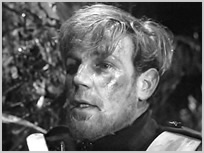 The scenes back on Kembel suddenly jump back to life, as we
are able to see an existing clip from the story – and it is instantly clear
that, as always, we are in safe hands with Douglas Camfield. Whilst much of the story is missing, it is
evident that it will have been very cleverly handled, based on clips like this –
the framing of the shots are wonderful, and there is a real sense of menace in
the way in which the Dalek towers over Gantry, mercilessly shooting him
down.
Steven’s fate is ultimately interwoven with that of Vyon –
upon observing the materialisation of the TARDIS, he follows the Doctor and
forces him to hand the keys over. Once
inside, he tries to persuade Katarina to take off – not that there’s any chance
of that, mind, since the poor girl doesn’t even understand the concept of a
key! – but is promptly knocked out when Steven sees the Doctor locked outside on
the scanner. Fortunately, the Doctor was
right about the planet being advanced enough to provide the drugs needed to
save Steven’s life, as Vyon carries some medicine with him in his
belt-pack. With Steven gradually recuperating,
unknown to the Doctor, we are left to see him discover what we as an audience
already know – the Daleks are on Kembel forging an alliance that will spell the
end of civilisation. Returning to the
TARDIS, he discovers that the doors are open, and the ship is surrounded.
 Of course, everything is alright though – Steven and
Katarina are lying some distance away, hiding.
This episode exists in the archives, and again it proves just how good a
director Douglas Camfield is. His use of
blocking is magnificent, and there are some real flairs here – moments like the
greeting between Zephon and Chen are beautifully realised, creating a grand
scale which we could only imagine of the first episode. Likewise, the framing of Courtney’s face as
he reveals his disgust at the presence of Mavic Chen on the planet is
wonderful; we are up close and personal, and his curl of the lips is
beautifully underplayed.
The Master of Zephon, a huge creature in a long black cowl
and with hairy hands and feet, is impressively played by Julian Sherrier – but sadly
less impressive when played by Hartnell, as the disguise is taken and Hartnell’s
Doctor is able to be proactive and disrupt the meeting. Whilst Sherrier was all about the grand
gestures – his entrance is magnificent as he strides confidently, arms
out-stretched, through the entrance hall - Hartnell instead elects a far softer more
docile approach, head bowed, arms crossed and quick steps. Quite how none of the other delegates are
suspicious is baffling – his feet are clearly not the fuzzy claws we saw
earlier, and his every mannerism is different.
Also, when Zephon finally gets back to his feet and sounds the alarm, he
is still wearing his cloak – surely he doesn’t have a cloak beneath his
cloak? Is he the equivalent of a Voord,
a man in a wetsuit with skin like a wetsuit, as was hinted at in The Keys of Marinus?

What is also interesting about this second episode existing,
of course, is the fact that it allows us to see
all of the other delegates – whilst stills exist from Mission to the Unknown, it has always remained unclear who exactly
was who. Toby Hadoke makes an
interesting suggestion in Running Through
Corridors regarding their character names based on the stature, and in one
case race, of the actors performing the roles.
Here, though, they have been recast – and several have been replaced
entirely. Gone is the Christmas Tree /
Sorting Hat, and in its place is a fascinating character moving in slow motion,
covered in balls. Again, the makeup is
superb here.
 Episode 2 is also important for another reason – until the
recovery of it in 2004, there was no existing footage of Katarina at all – as such,
we had no way of seeing exactly how Adrienne Hill played her, only able to hear
her rather disjointed and staccato delivery at the end of The Myth Makers and on the soundtrack to this serial. Now that we can see it, however, it becomes
far more interesting; whilst she always
sounded rather monotonous and uninspired, her performance is beautifully played
with little quirks and nuances, as she walks around in a daze constantly, arms
floating airily by her side. She also
provides a cracking cliffhanger, wonderfully poignant as she exclaims that they
cannot leave without the Doctor – “Without him, we can’t reach the place of
perfection”. The desperation in her
voice is clear, and it is telling that even with the Doctor’s insistence that
he is not a god, she still sees him as a saviour, one without whom they stand
no chance. It speaks volumes about the
way in which the show is still progressing, as since Ian left, the Doctor has
become far more proactive.
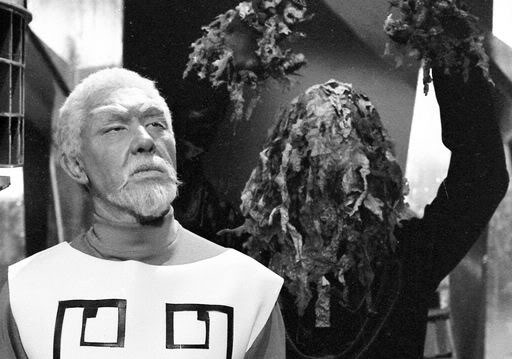
Episode 3 leaves us back to only having a soundtrack and a
few existing clips, but based on the soundtrack alone it is quite a belter –
the scene in which the Daleks stand by, watching the war of words between Mavic
Chen and Zephon is wonderful, and Kevin Stoney, as Chen, is simply
breathtaking. The arrogance and
corruption oozes from him, and he is spectacular in scenes like this. What is also fantastic is that after the
ludicrously debasing saga of The Chase,
the Daleks are genuinely threatening again – the carelessness on their part is
fantastically played, as whoever loses this verbal sparring will be executed,
as simple as that. They do not care who dies, but someone will, to pay the
price for the failing.
 The scenes on Desperus – because the convicts are
desperate... gettit?! – sound great too.
The in-fighting between the convicts over ownership of the knife is
wonderful, and what is interesting is that it is Kirksen who survives on the
planet and enters the airlock before the Spar takes off again. Easily the weakest of the three, it is he who
shows cunning, and leads wonderfully into the cliffhanger, which is possibly
the first time a scream has seamlessly melded into the closing credits –
something which Bonnie Langford will make every effort to do week-in-week-out
in the 1980s. Here, it is the Doctor’s
carelessness which has led to Kirksen gaining entry – he left the external door
open because he isn’t “used to this kind of craft”. Likewise, it is he who sends Katarina to
check on the door, leading her to her impending death.

The death scene, in episode 4, still exists, and the
struggle between Katarina and Kirksen is horrible to watch, as the pair tussles
inside the airlock, and Bret’s refusal to change direction, builds up the
tension and the drama nicely. When she
pushes the button to expel both herself and the convict into space, it is
heartbreaking, and Purves’ delivery as he screams her name is wonderfully
touching. Even more powerful, though, is
Hartnell’s speech, as he says that “She
wanted to save our lives and perhaps the lives of all the other beings of the
Solar System. I hope she's found her Perfection. Oh, how I shall always
remember her as one of the Daughters of the Gods. Yes, as one of the Daughters
of the Gods.” It is a speech which
should be up there with the “I shall come back” speech of The Dalek Invasion of Earth, yet is largely unknown because of the
lack of existent material.
This scene also
marks an important first – the death of a companion should not be underrated,
as it is a powerfully emotive scene, and one which further highlights the danger
of the Doctor’s lifestyle. Whilst each
serial invariably features a character nearly meeting their end – whether by a
sword, a ray gun, a depressurised airlock or what you will – they are always
seen to be saved. Here, though, we
realise that the Doctor loses. Or more
importantly, that the Doctor can lose. Later in this episode, we have the death of
Bret Vyon, and he receives no eulogy whatsoever; the Doctor and Steven simply believe he’s
fallen back somewhere, and even when they discover his fate, little is said or
done about it. It will not be until Earthshock in the 1980s that a companion
should suffer such an emotively-strung fate again, but this is beside the
point. If companions were frequently
shown to die, it would remove some of the wonder and fantasy that time travel
entails. It is enough to simply show
that they can die. Interestingly, had Vicki not left the series
in the episode before, it would have been her to have died in that airlock, and
that frequently doesn’t even bare thinking about – Katarina had only travelled
briefly with the Doctor, and it was heartbreaking, but if it had been Maureen O’Brien
instead, goodness knows how I’d have felt.

The return to Earth
also sees the introduction of Jean Marsh’s character, Sara Kingdom. Last seen in The Crusade, Marsh brings a sense of coldness to this character,
crisp and clipped in tone, dressed in a black cat suit. Her brisk manner underlies the danger she
poses, and her calm willingness to follow orders is wonderful when seen in
juxtaposition with her performance in episode 5. Also on Earth is the man Bret Vyon trusts
implicitly, Daxtar, played wonderfully by Roger Avon (also from The Crusade). Daxtar’s treachery is uncovered rather
simplistically, however, using the old trick which we saw most recently in The Time Meddler – he is obviously a spy
because he knows things that the TARDIS crew haven’t yet told him. Bret’s argument that “I’ve known this man all
my life” is quickly undermined when he executes him in cold blood for his
betrayal.
Equally
cold-blooded is the execution of Vyon, by Sara Kingdom, who accuses him of
treasonous behaviour. The efficiency
with which she guns him down, followed by her orders to kill the Doctor and
Steven, are troubling enough – but her addition of “aim for the head” makes the
blood run cold.

Episode 5 exists,
which is both a blessing and a curse – sadly, this episode is the weakest of
the serial so far, featuring clumsy Daleks and mice. Essentially a reread of The Chase, up to now, the story has bounced from location to
location, with our heroes only ever being breathing distance from the next
threat. Now that they are being pursued
by Daleks, the similarity becomes even more noticeable. What this episode does do very well, though,
is cement what we heard in episode 4 –
and that is that Stoney is simply magnificent.
In episode 2, particularly with Zephon, he was great. Here though, away from funny looking aliens
and tin-pot wannabe dictators, he smoulders brilliantly. His scenes with Karlton, played by the
impressively-bald looking Maurice Browning, are fantastic, as he rants about
power and see his quirky mannerisms underlying the danger of the maniac. Likewise, we are able to see Stoney through
Browning’s eyes too – he is clearly aware that his boss is going crazy, yet is
willing to goad him, to push him onwards.
Karlton is actually the brains of this operation – the ultimate spin
doctor, in fact, as he works to turn the situation into an advantage for them
both. It’s wonderful to see, and in
lesser hands, both roles would have been hammy and over-the-top, but instead
the performances are low-key when they need to be, filled with explosive
bombast the next moment – and always brilliant.
The revelation that
Kingdom was related to Bret – “Bret Vyon was my brother” – is stunning, and
delivered wonderfully. In the last
episode, Kingdom was a threat to our travellers, but now, forced to unite with
them, her character needs a quick 180-degree turn, becoming an ally. It should feel forced and tacky, but the cast
work with the principal wonderfully, with Steven’s bluster turning to
embarrassment, and Hartnell showing clear sympathy for a woman who was simply
doing her duty.

On the planet Mira –
it’s like a mire, a swamp, see? – the three are forced to work together as they
do battle with the Visians, the first invisible monsters in Doctor Who history (although they
certainly won’t be the last!) Added to
this the threat of the Daleks, and the tension is ramped up successfully for
Hartnell’s line at the cliffhanger – “I’m afraid, my friends, that the Daleks
have won”. We’re only five episodes in,
and it would appear that the serial is winding itself up – a contemporary
audience would have had no idea that this particular story is due to run for 12
weeks.
Episode 6 is
something of a blessing, really – it sees the writing credits handed over to
the wonderful Dennis Spooner, and the dialogue instantly feels richer and more
varied. Whilst Nation is a perfectly
adept writer – at times – the serial suddenly feels fresher and more natural
under Spooner’s pen, and it somehow lifts the pace of the serial too.
 Peter Purves is
excellent in this episode – feeling useless and outdated, his act of courage
and bravery is wonderfully played, a man desperate to have some impact. Sadly, of course, we can’t see his performance, but based on Purves’
own narration on the audiotrack, I bet it was great – “With a struggle, Steven
manages to blink his eyes”. The plot
device is wonderfully simple too – creating a false core that looks and feels
identical is a little clichéd, and in Nation’s hands it almost certainly would
have been, but Spooner creates a sense of urgency about the whole thing – as the
ship is being drawn back to Kembel, it is Steven’s sacrifice which saves them.
 Likewise, as the
handover is performed outside the TARDIS, it is Steven who makes the whole
thing possible – thanks to the field around him, he is able to hand the false
taranium core back to the Daleks and escape into the ship without coming to any
harm. The sixth episode comes to a close
somewhere, unknown due to the broken scanner, but with horrifically poisonous
readings. One could be forgiven for
thinking that, once and for all, The
Daleks’ Master Plan has been defeated...


